|
|
Cheng-Xiang
Wang (王承祥), PhD, FIEEE, FIET, FHEA Head of Advanced
Wireless Technologies (AWiTec) Lab (EM
1.30) Office: EM 2.14; Lab: EM 1.30 |

Biography
|
Research |
Teaching | Administration | Lab Members | Awards | Professional Activities | Publications| Vacancy (0)|
Biography
Cheng-Xiang
Wang received the BSc and MEng degrees in Communication and Information Systems
from Shandong University, China, in 1997 and 2000, respectively, and the PhD
degree in Wireless Communications from Aalborg University, Denmark, in 2004.
He has been with Heriot-Watt University, Edinburgh, UK
since 2005, and became a Professor in Wireless Communications in 2011. He was a
Research Fellow at the University of Agder, Grimstad, Norway, from 2001-2005, a Visiting Researcher at
Siemens AG-Mobile Phones, Munich, Germany, in 2004, and a Research Assistant at
Hamburg University of Technology, Hamburg, Germany, from 2000-2001. His current
research interests focus on wireless channel measurements/modelling and (B)5G
wireless communication networks, including green communications, cognitive radio
networks, high mobility communication networks, massive MIMO, millimeter wave
communications, and visible light communications. He has co-authored 2 books, 1
book chapter, and over 340 papers in refereed journals and conference
proceedings.
Prof. Wang has served as an editor for 9 international
journals, including the IEEE TRANSACTIONS ON VEHICULAR TECHNOLOGY (since 2011),
IEEE TRANSACTIONS ON COMMUNICATIONS (since 2015), and the IEEE TRANSACTIONS ON
WIRELESS COMMUNICATIONS (2007--2009). He was the lead Guest Editor for the IEEE
JOURNAL ON SELECTED AREAS IN COMMUNICATIONS, Special Issue on Vehicular
Communications and Networks. He was also a Guest Editor for the IEEE JOURNAL ON
SELECTED AREAS IN COMMUNICATIONS, Special Issue on Spectrum and Energy Efficient
Design of Wireless Communication Networks and Special Issue on Airborne
Communication Networks, and a Guest Editor for the IEEE TRANSACTIONS ON
BIG DATA, Special Issue on Wireless Big Data. He has served as a Technical
Program Committee (TPC) Member, TPC Chair, and General Chair for over 80
international conferences. He received 9 Best Paper Awards from IEEE Globecom 2010, IEEE ICCT 2011, ITST 2012, IEEE VTC
2013-Spring, IWCMC 2015, IWCMC 2016, IEEE/CIC ICCC 2016, and WPMC 2016. He is a
Fellow of the IEEE, IET, and HEA. He is recognized as a Web of Science 2017
Highly Cited Researcher.
Research
Research Interests:
Wireless channel measurments and modelling
Green (energy efficient) communications
Cognitive radio networks
Vehicular communication networks, high-speed train communication networks
Massive MIMO, Cooperative MIMO communications
millimeter wave communications, visible light communications, THz
communications
(B)5G wireless communication networks, converged optical and wireless networks
Research Projects:
5G RuralFirst: Rural Coverage and Dynamic Spectrum Access
Testbed and Trial, Supported by DCMS (5G Testbeds and Trials Programme: Phase 1), 1 June
2018-31 May 2019.
Downhole Wireless RF Communications System for Deployment in Oil and Gas Wells, Supported by Oil and Gas Innovation Centre (OGIC), 1 August
2018-31 July 2021.
A Unified Multiple Access Framework for Next Generation Mobile Networks By
Removing Orthogonality, Supported by EPSRC (Ref.: EP/P009670/1), 1 May 2017-30 April 2020.
Testing and Evaluating Sophisticated information and communication Technologies
for enaBling a smartEr grid
(TESTBED),, Supported by Research and Innovation
Staff Exchange (RISE) Scheme (H2020-MSCA-RISE-2016), European Commission, 1
January 2017-31 December 2019.
Innovative Architectures,
Wireless Technologies and Tools for High Capacity and Sustainable 5G
Ultra-Dense Cellular Networks (5G Wireless),
Supported by Horizon 2020, MARIE SKŁODOWSKA-CURIE ACTIONS, Innovative
Training Networks (H2020-MSCA-ITN-2014), European Commission, 1 January 2015-31
December 2018.
Large Scale Antenna Systems Made
Practical: Advanced Signal Processing for Compact Deployments [LSAS-SP], Supported by EPSRC (Ref.: EP/M014126/1), 15 January 2015-14
January 2018.
TOwards Ultimate Convergence of All Networks
(TOUCAN), Supported by EPSRC Programme Grant (Ref: EP/L020009/1), 11
November 2014-10 November 2019.
Quality-of-Experience Improvement for Mobile
Multimedia across Heterogeneous Wireless Networks (QUICK), Supported by International Research Staff Exchange Scheme
(FP7-PEOPLE-2013-IRSES), European Commission, 1 July 2014-30 June 2018.
Non-Stationary IMT-A MIMO Channel
Models with Time-Varying Parameters, Supported by
Huawei Technologies,
15 August 2014-14 August 2015.
Key Technologies for 5G Wireless
Communication Networks, Supported by SNCS Research
Center, the University of Tabuk, and the Ministry of Higher Education in Saudi
Arabia, 1 Oct. 2013-30 April 2015.
Test and Consultancy of
Intelligent Wireless Communication Transceiver,
Supported by
Scottish
Funding Council, 22 June-31 December 2012.
End to End Capacity
Management of Mobile Broadband Networks,
Supported by
Hutchison
3G UK, 1 March 2012-28 February 2015.
Ambulatory Transcranial
Doppler Ultrasound, Supported by Southern General Hospital, Glasgow, UK, 19 September
2011-18 September 2015.
Radio Resource Management
for Cognitive Green Communication Networks,
Supported by
Hutchison
3G UK, 1 June 2011-31 May 2014.
Realistic MIMO Channel
Models for 3GPP LTE and IMT-Advanced,
Supported by
Huawei
Technologies, 2 May 2011-30 June 2013.
UK-China Science
Bridges: R&D on (B)4G Wireless Mobile Communications, Supported by Research Councils UK (EPSRC Grant Information), 1 August 2009-31 July 2012.
Spectral-Energy Efficiency
Tradeoff of Cooperative Communication Networks,
Supported by the
EPSRC
and
Mobile
VCE Core 5, 1 Jan. 2009-31 March 2012.
A Study of the Effect of
Local Objects on Indoor Propagation Channels,
Supported by the
EPSRC
and
National Physical
Laboratory (NPL), EngD Studentship, 2 Feb. 2009-1 Feb. 2013.
Synchronisation Techniques for ECMA-368 Ultra-Wideband and DECT
Wireless Systems, Supported by the
EPSRC and
TES Electronic Solutions,
EngD
Studentship, 18 Sept. 2008-17 Sept. 2012.
Interference Modelling and
Management for Cognitive Radio Networks,
Supported by ERP JRI-SIP, PhD Studentship, Nov. 2007-Nov. 2010.
Error Models for Digital
Channels and Applications to Wireless Communication Systems, Supported by the EPSRC and Philips Research Cambridge, CASE for New Academics (CNA), 1 June 2007-30 Nov.
2010.
MIMO Channel Modelling and
Simulation for Cellular and Mobile-to-Mobile Communication Systems, Supported by
ERP
JRI-SIP, PhD Studentship, 1 Oct. 2006-30 Sept. 2009.
A Study on Novel PAPR Reduction
Methods in OFDM Wireless Communication Systems,
Supported by the Royal Society of Edinburgh, UK, Feb. 2007.
A Rapid Multipath MIMO
Channel Simulator for E-UTRA and E-UTRAN,
Supported by
BenQ
Mobile, Germany, 2005-2007.
Advances in Exploration Methods and
Applications (ADEMA), Supported by the European Commission's
Research Fund for Coal and Steel, 2005-2008.
Teaching
UG Module B37VA1: Praxis
Electronic Design (Semester 1 2017/2018, 2016/2017, 2015/2016)
UG Module B38CN2: Introduction to Communications and Networks (Semester 2
2016/2017)
MSc Module B31SI2: Principles of Mobile Communications (Semester 2 2016/2017,
2015/2016, 2014/2015, 2013/2014, 2012/2013, 2011/2012, 2010/2011, 2009/2010,
2008/2009)
MSc Module B31SF1: Communications & Networks (Semester 1 2014/2015,
2013/2014, 2012/2013, 2011/2012, 2010/2011, 2009/2010, 2008/2009)
UG Module B38DB1: Digital Design and Programming (Semester 1 2014/2015)
MSc Module B30PA1: Software Engineering 1 (Semester 1 2009/2010, Semester 1
2008/2009)
MSc Module B39JT2: Principles of Mobile Communications (Term 2 2007/2008)
MSc Module B39QE1: Communications & Networks (Term 1 2007/2008, Term 1 2006/2007,
Term 1 2005/2006)
MSc Module B39DQ1: Computer Hardware (Term 1 2007/2008)
MSc Module B39CN2: Communications 2 (Term 2 2006/2007, Term 2 2005/2006)
Administration
Deputy Head of Institute of Sensors, Signals and Systems (since June
2014)
Programme Director for
BEng
Telecommunications Engineering (since Jan. 2015)
Programme Director for
MSc
Mobile Communications (2008-May 2015)
Director for EPS China Development Group
Lab Members (Lab Photo1,
Lab Photo2,
Lab Photo3,
Lab Photo4)
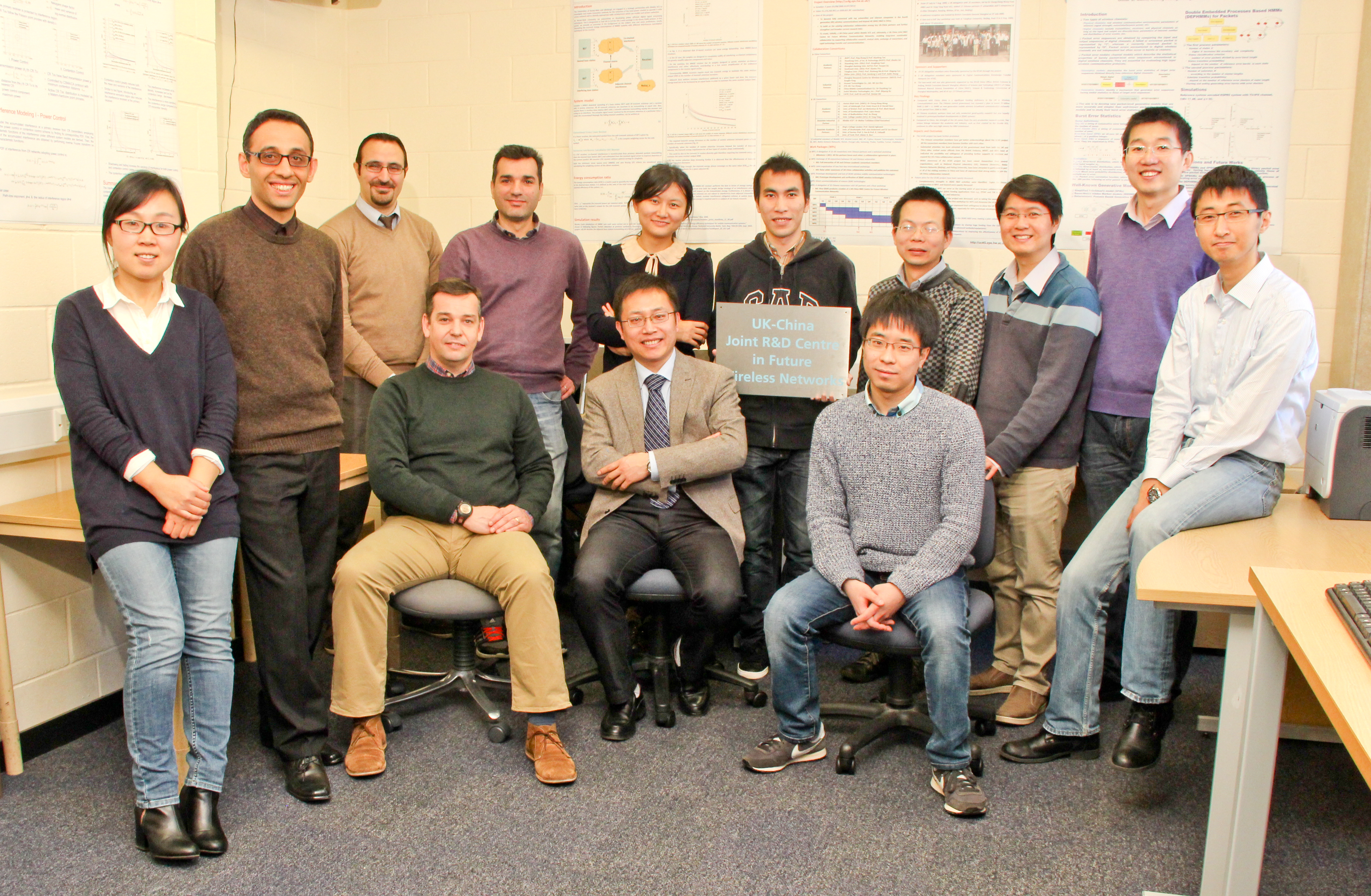
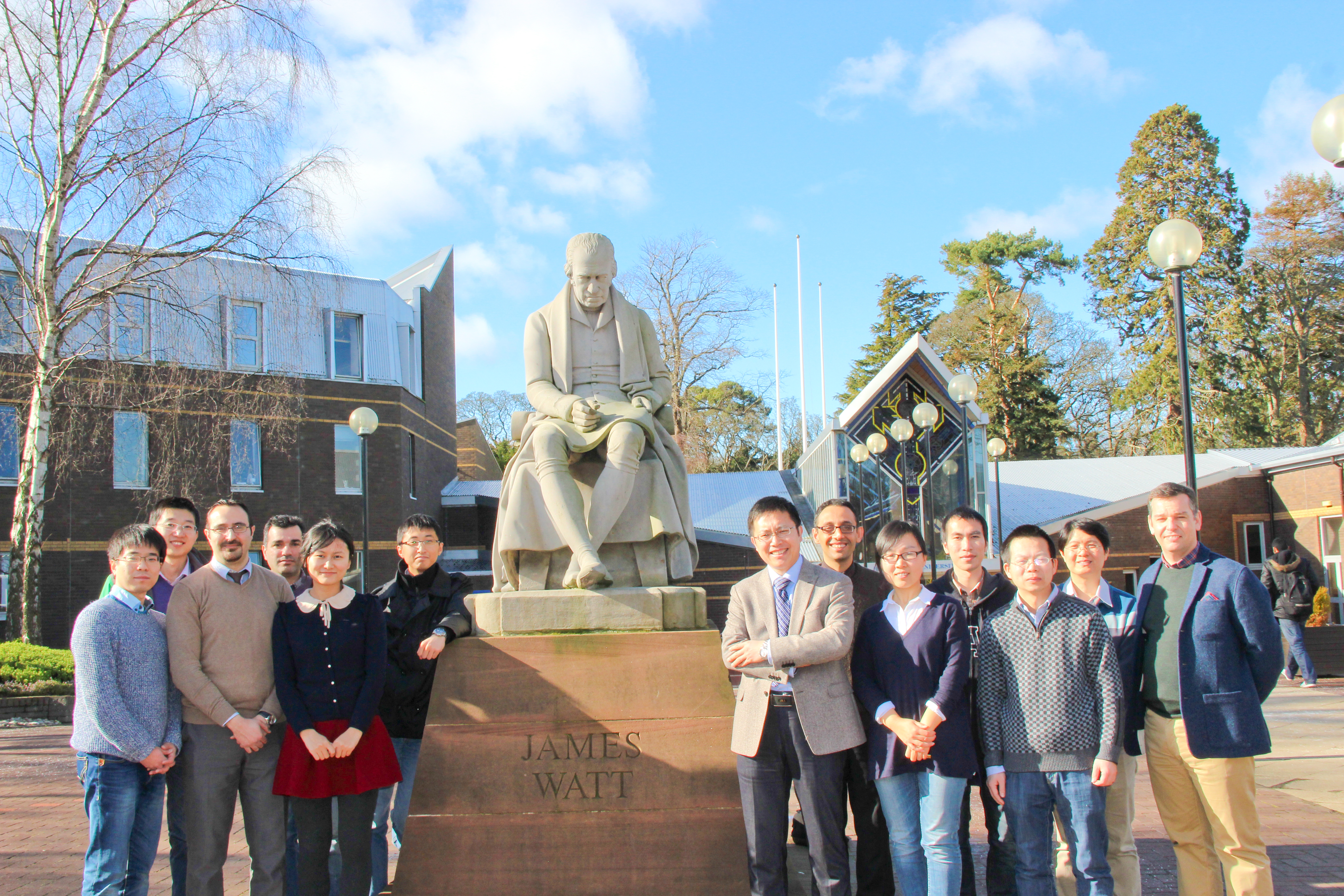

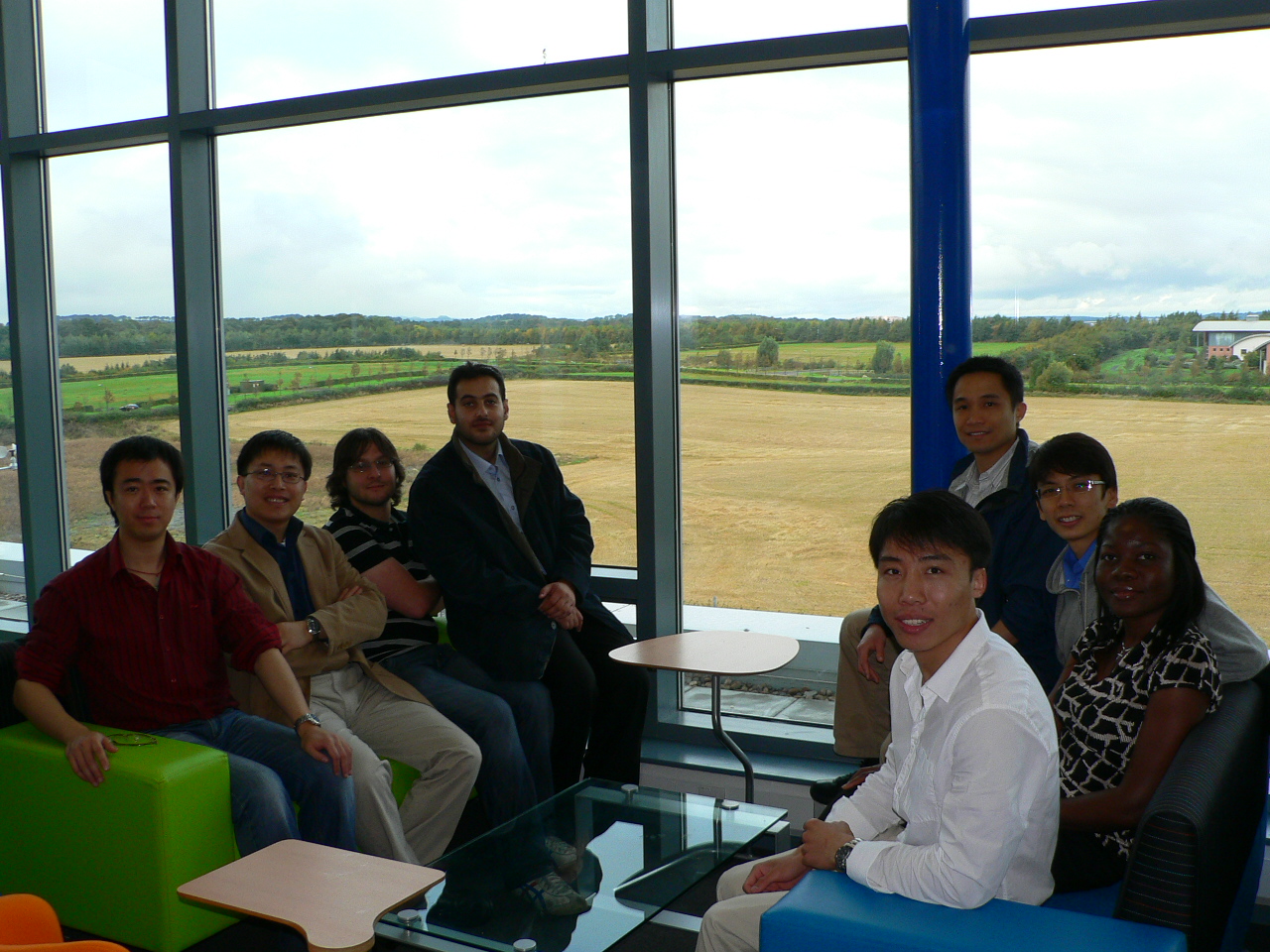
Current Research Associates (3):
Dr. Yu Fu, PDRA
for the project TOwards Ultimate Convergence of All
Networks (TOUCAN), 1 May 2016 ~ 1 November
2019.
Mr.
Carlos Lopez, Early Stage Researcher for the project Innovative Architectures, Wireless Technologies
and Tools for High Capacity and Sustainable 5G Ultra-Dense Cellular Networks
(5G Wireless), 16 September 2015 ~ 15 September
2018.
Mr. Yi
Tan, Early Stage Researcher for the project Innovative Architectures, Wireless Technologies
and Tools for High Capacity and Sustainable 5G Ultra-Dense Cellular Networks
(5G Wireless), 16 September 2015 ~ 15 September
2018.
Current PhD Students (2):
Mr. Carlos Lopez,
Large-Scale and Spatial Modulation MIMOs: Algorithms, 3D Channel Modelling and
Experiments, 16 September 2015 ~
Mr. Yi
Tan, Measurement-Based Statistical Channel Modelling of mmWave Communications, 16 September 2015 ~
Current Co-supervised PhD Students:
Mr. Andrew Thompson (Heriot-Watt University; Main
Supervisor: Prof. David Wolfe Corne), "Exploring Self-Optimisation for Next Generation Mobile Networks",
August 2008 ~
Mr. Xuhua Wang
(Heriot-Watt University; Main Supervisor:
Dr. Xu Wang),
"Security and Energy Efficiency in Optical Communication Networks",
Dec. 2009 ~
Mr. Abdelhamid H. F.
Younis (The University of Edinburgh; Main Supervisor:
Prof.
Harald Haas), "Spatial Modulation Techniques", 2010 ~
Previous Postdoctoral Research Associates (7):
Dr. Xuemin Hong,
Network Manager for the project UK-China Science Bridges: R&D on (B)4G Wireless Mobile Communications, 1 August 2009 ~ 31 July 2011.
Dr.
Pat Chambers, Wireless MIMO Testbed Developer for the project UK-China Science Bridges: R&D on (B)4G Wireless Mobile
Communications, 11 July 2011 ~ 31
July 2012.
Dr.
Zengmao Chen, Network Manager for the project UK-China Science Bridges: R&D on (B)4G Wireless Mobile
Communications, 1 August 2011 ~ 31
July 2012. Dr. Piya Patcharamaneepakorn, PDRA in Massive MIMO
Systems for the project Key
Technologies for 5G Wireless Communication Networks,
1 May 2014 ~ 30 April 2015.
Dr.
Xianyue Wu, PDRA in mmWave Channel
Measurements and Modelling for the project Key Technologies for 5G Wireless Communication Networks, 1 May 2014 ~ 30 April 2015.
Dr.
Yan Zhang, PDRA for the project Non-Stationary IMT-A MIMO Channel Models with Time-Varying
Parameters, 15 August 2014 ~ 14 August 2015.
Dr.
Liang Gong, PDRA for the project TOwards Ultimate Convergence of All Networks
(TOUCAN), 1 May 2015 ~ 6 May 2016.
Graduated PhD Students (15):
Dr Xuemin Hong,
“Secondary Mobile Access via Ultra-Wideband and Cognitive Radio Networks”,
October 2005 ~ October 2008 (successful viva on 10 October 2008); now
Associate Professor in Xiamen University, China.
Dr
Xiang Cheng, “MIMO Channel Modelling and Simulation for Cellular and
Mobile-to-Mobile Communication Systems”, October 2006 ~ October 2009 (successful
viva on 6 October 2009); now Associate Professor in Peking University,
China.
Dr
Michail Matthaiou (University of Edinburgh; Main Supervisor:
Dr David Laurenson),
"Characterisation and Modelling of Indoor and
Short-Range MIMO Communications", September 2005 ~ November 2008 (successful
viva on 7 November 2008); now Assistant Professor in
Chalmers University of
Technology, Sweden.
Dr. Jun Zhou
(University of Edinburgh; Main Supervisor:
Dr John Thompson),
"Interference Mitigation for Cognitive Radio", September 2005 ~2009.
Dr. Hongjian Sun
(University of Edinburgh; Main Supervisor:
Dr David Laurenson),
"Collaborative Spectral Sensing in Cognitive Radio Networks", June
2007 ~ Dec. 2010 (successful viva on 20 December 2010); now Lecturer in
Durham University, UK.
Dr.
Zengmao Chen, “Interference Modelling and Management for Cognitive
Radio Networks”, November 2007 ~ May 2011(successful viva on 12 May 2011);
now Assistant Professor in Nanjing University of Technology, China.
Dr.
Omar Saeed Salih, “Error Models for Digital Channels and
Applications to Wireless Communication Systems”, 1 June 2007 ~June 2013 (successful
viva on on 23 June 2013); now Assistant Lecturer
in Coventry University, UK.
Dr.
Chui Choon Ivan Ku, “Spectral-Energy Efficiency Tradeoff of
Cooperative Communication Networks”, 22 April 2009 ~June 2013 (successful
viva on on 24 June 2013); now Lecturer in
Malaysia International University, Malaysia.
Dr. Yi
Yuan, “MIMO Channel Modelling and Simulation for Advanced Wireless Communication
Systems”, 18 January 2010 ~1 May 2014 (successful viva on 1 May 2014);
now Wireless Engineer-Specialist/R&D at
Ocado Technology,
London.
Mr. Yu
Fu, “Performance Investigation of Spatial Modulation Systems Under
Realistic MIMO Channel Models”, 15 November 2010 ~ April 2015 (successful
viva on 28 April 2015); now Postdoc at HWU.
Mr.
Fourat Haider, “Spectral-Energy Efficiency Tradeoff for
Next-Generation Wireless Communication Systems”, 6 December 2010 ~ June 2015 (successful
viva on 5 June 2015); now with Hutchison 3G UK.
Mr.
Ammar Ghazal, “Propagation Channel Characterisation
and Modelling for High-Speed Train Communication Systems”, 14 January 2011
~June 2015 (successful viva on 11 September 2015); now Early Career
Academic Fellow with
School of Engineering and
Sustainable Development, De Montfort University, Leicester, UK.
Mr.
Shangbin Wu, “Channel Characterisation and
Modelling for Massive MIMO 5G Wireless Communication Systems”, 28 September
2012 ~June 2015 (successful viva on 30 September 2015); now with Sumsung UK.
Mr.
Ahmed Al-Kinani, “Channel Modelling and Interference Management
Techniques for Visible Light Communication Networks”, September 2013~November
2017 (successful viva on 28 Novemer 2017)
Miss
Qianru Zhou, “End-to-End Performance Evaluation of Converged Optical
and Wireless Networks”, 20 January 2015~May 2018 (successful viva on 3 May
2018)
Graduated EngD Students (2):
Miss Margaret Uzunma
Anyaegbu, “Synchronisation Techniques for
ECMA-368 Ultra-Wideband and DECT Wireless Systems”, 18 September 2008~July 2013
(successful viva on on 19 July 2013); now
Engineer in TES Electronic Solutions Ltd., Edinburgh, UK.
Mr
Sandy Weir, “Channel Characterisation and
Modelling for Transcranial Doppler Ultrasound”, 19 September 2011~October 2016
(successful viva on on 28 October 2016); now
Head of Software Engineering (Medical Devices Unit), Southern General Hospital,
Glasgow, UK.
Graduated MSc Students by Research (2):
Mr
Raul Jose Hernandez Fernandez,
“Metrology-Oriented Wireless Communication Technologiess”,
2 February 2009~June 2011;(l via on 11 July 2011).
Mr
Ammar Ghazal, “Comparison of Standardised
MIMO Channel Models for 4G Wireless Communication Systems”, 30 October 2009 ~
October 2010 (successful viva on 8 October 2010); now PhD student in
Heriot-Watt University, UK.
Graduated MEng Students (2):
Mr Cameron Craig, “Hardware Accelerated MPEG Transport Stream
Encryption using the Integrated Security Engine of a Freescale QorIQ P1022 Communications Processor”, June-Dec. 2016.
Miss Yola Jones, “Expanding
Functionality of an Embedded Device”, June-Dec. 2017.
Graduated MSc Students (34):
Mr Yuhang Zhang, “3D Channel Models for Visible Light Communication Systems”, Feb.-Sept. 2018.
Mr Xiaotong Shen, “3D Tunnel Channel Models for
High-Speed Train Wireless Communication Systems”, Feb.-Sept. 2016.
Mr Wei Lu,
“Space-Frequency Index Modulation Wireless Communication Systems”, Feb.-Sept.
2015.
Mr Wenyu Sun,
“System Level Performance of Massive MIMO Wireless Communication Systems”,
Feb.-Sept. 2015.
Mr Jin Ju,
“Channel Models for High-Speed Train Wireless Communication Systems”,
Feb.-Sept. 2015.
Mr Bin Lin,
“Wireless Body Area Networks for Medical Monitoring Applications”, Feb.-Sept.
2014.
Mr Zhou Zhou,
“A Performance Study of Spatial Modulation Techniques under High Velocity
Channel Models”, Feb.-Sept. 2014.
Mr Clément Robert,
“Spectrum Learning for Cognitive Radio Networks”, Feb.-Sept. 2013.
Mr Seven Marderosian,
“Traffic Analysis and Management in LTE Mobile Cellular Systems Using Opnet”, Feb.-Sept. 2013.
Mr Li JIANG,
“A Performance Study of Spatial Modulation Techniques under High-Speed Train
Channel Models”, Feb.-Sept. 2013.
Mr Yi Lu, “Multi-Frequency
Wireless Channel Measurements and Characterisation
using the NI Testbed ”, Feb.-Aug. 2012.
Ms Gunash Rostamiaminlou,
“A Performance Study of Spatial Modulation Techniques under High Velocity
Channel Models”, Feb.-Aug. 2012.
Ms Jiawei Song,
“A Performance Study of Spatial Modulation Techniques Using MIMO Channel
Models”, Feb.-Aug. 2012.
Ms Aruna P. Vivekanand,
“High Development of a Demonstrator for LTE Mobile Communication Systems”,
Feb.-Aug. 2011.
Mr Pradeep Kemparaju,
“Software Defined Radio on GPP-based Parallel Computing Platform”, Feb.-Aug.
2011.
Mr Fengfeng Wu,
“Development of an OFDM Modem for a 4G Wireless Testbed”, Feb.-Aug. 2011.
Mr Yu Fu,
“High Performance Software Radio Platform for LTE Systems”, Jan.-Aug. 2010.
Miss Ting Lang,
“Performance Measurement of LTE Transmitters and Receivers”, Jan.-Aug. 2010.
Mr. Osama Elhodaire,
“Carrier Aggregation for LTE-Advanced Systems”, Jan.-Aug. 2010.
Mr. Robert Hemesley,
“Development of a FPGA-based Software Defined Radio Platform”, Jan.-Aug. 2010.
Mr Yi Yuan,
“A Study on Three-Dimensional Mobile-to-Mobile Channel Models”,
February-September 2009.
Miss Xiang Zhu,
“Adaptive Generative Models for Digital Wireless Channels”, February-September
2009.
Miss Jing Huang,
“Interference Modelling for Cognitive Radio Systems”, February-September 2009.
Mr Ruoheng Huang,
“Hidden Markov Modelling of Digital Wireless Channels”, January-June 2009.
Mr.
Chinazom Wilson Uwaoma, “Impact of Spatial Correlation and Mutual
Coupling on MIMO Channel Capacity”, May-August 2008.
Mr. Chuan Wang,
“Interference Mitigation for Cognitive Radio Systems”, May-August 2008.
Mr. Luis Alfredo Mateos
Guzman, “A Study on MIMO Mobile-To-Mobile Wireless Fading Channel
Models”, March-June 2008.
Mr.
Cheng Zhou, “A Study on Distributed MIMO Systems Based on UWB WBAN”,
May-September 2007.
Mr. Md Mokaddes Hossain,
“A Performance Study of Space-Time-Frequency Coded MIMO MB-OFDM Wireless
Communication Systems”, May-September 2007.
Mr.
Kingsley Ebruke, “A Study on Geometrically-Based Stochastic MIMO Channel
Models”, May-September 2007.
Mr.
Masood Ahmad Jan, “An Investigation of Correlation Based Stochastic
MIMO Channel Models”, May-November 2006.
Mr. Simon Marsol,
“An Investigation into the Suitability of Simulink and System Generator Tools
for Generating FPGA Codes from High Level Design of Pulse Compression”,
May-September 2006.
Ms. Sudhamathy Muthuvel,
“The Characterisation of MIMO-UWB Channels”,
May-September 2006.
Mr. Thierry Reynaud,
“Error Models for MB-OFDM Wireless Communication Systems”, May-September 2006.
Current Final-Year Student:
Graduated Final-Year Student:
Mr Ilias Dimopoulos,
“A Performance Study of Spatial Modulation Techniques Under High Velocity
Channel Models”, September 2012-April 2013.
Mr Ibrahim Abotaibi,
“Realistic MIMO Channel Models for Advanced Wireless Communication Systems”,
September 2011-April 2012.
Mr Robert Muhumuza,
“Realistic MIMO Channel Models for 4G Wireless Communication Systems”,
September 2010-April 2011.
Mr Philip Taylor,
“Simulator of LTE Wireless Communication Systems”, September 2009-April 2010.
Miss Aine McGarry,
“Comparison of Two Types of Sum-of-Sinusoids Mobile Fading Channel Simulators”,
October 2007-June 2008.
Honours and Awards
2017 Editor Outstanding
Contributions Award, Science China Information
Sciences, Mar. 2018
Web of
Science
2017
Highly Cited Researcher, Clarivate Analytics, 15
November 2017
Fellow of the IEEE, 'for contributions to wireless channel modeling
for vehicular networks', from 1 January 2017
Best Student Paper Award, WPMC’16, Shenzhen, China, Nov. 2016
Best Paper Award, IWCMC’16, Cyprus, Sept. 2016
Best Paper Award, IEEE/CIC ICCC’16, Chengdu, China, July 2016
2015 Editor Outstanding Contributions Award, Science China Information
Sciences, Mar. 2016
Best Paper Award, IWCMC’15, Croatia, Aug. 2015
Graphical System Design Achievement Award (RF and Communications) for
"Wireless Testbed Solution for Novel Future Generation Communication
Systems", National Instruments, London, UK, 19 Nov. 2013
Best Student Paper Award, IEEE VTC’13-Spring, Las Vegas, USA, Sept. 2013
Best Paper Award, ITST’12, Taiwan, Nov. 2012
Guest Professor, Southeast University, P. R. China, from 20 Aug. 2012
Fellow of the IET, from 3 April 2012
2 Best Paper Awards (Top 2%), IEEE ICCT’11, Jinan, China, Sept. 2010
Best Paper Award (Top 0.3%), IEEE Globecom’10, Miami, USA, Dec. 2010
Chair Professor, Shandong University, P. R. China, Dec. 2010-Dec. 2013
Guest Professor, Huazhong University of Science and Technology, P. R.
China, Mar. 2010-Mar. 2013
Biography listed in "2009 Man of the Year",
2009
Biography listed in "Great Minds of the 21st Century
2009", 4th Edition, 2009
Biography listed in "Who's Who in the World
2009", 26th Edition, 2009
Biography listed in "Dictionary of International
Biography 2009", 35th Edition, 2009
Biography listed in "Dictionary of International
Biography 2008", 34th Edition, 2008
Biography listed in "Who's Who in the World
2008", 25th Silver Anniversary Edition, 2008
Guest Researcher, State Key Lab of Integrated Service
Networks,
Xidian
University, P. R. China, from Jan. 2007
Adjunct Professor, Guilin University of Electronic Technology, P. R.
China, from June 2006
Honorary Fellowship,
School
of Engineering & Electronics, University of Edinburgh, Edinburgh, UK, from June
2006
Short Term Visiting Professor, Shandong University, September 2005, April 2006,
April 2007, June 2008, April 2009, and April 2010
Excellent Master Thesis Award, Shandong, P. R. China, 2001
Scientific Project Improvement Award, Shandong, P. R. China,
2000
Siemens Scholarship, 2000
Best Paper Award, the sixth National Youth Communication
Conference, Beijing, P. R. China, 1999.
Member, Siemens International Students Circle (SISC),
Siemens, 1999
Professional Activities
Editorial Board Member/Editor/Associate Editor (9):
IEEE
Transactions on Communications (2015-)
IEEE
Transactions on Vehicular Technology (2011-)
Wireless Communications and Mobile Computing Journal
(2007-)
SCIENCE CHINA Information Sciences (SCIS) (中国科学F-信息科学),
Science China Press and Springer (2012-)
Physical Communication Journal, Elsevier (2012-2015)
InTech (Open Access Publisher) Scientific Board
(2011-2012)
IEEE Transactions on Wireless Communications
(2007-2009)
Security and Communication Networks Journal
(2007-2013)
Hindawi
Journal of Computer Systems, Networks, and Communications
(2007-2011)
Special Issue on: "Aireborne
Communication Networks"(CFP),
IEEE Journal on Selected
Areas in Communications.
Special Issue on: "Wireless Big Data"(CFP),
IEEE Transactions
on Big Data.
Special Issue on: "Spectrum and Energy
Efficient Design of Wireless Communication Networks"(CFP),
IEEE Journal on Selected
Areas in Communications.
Special Issue on:
"Vehicular Communications and Networks"(CFP),
IEEE Journal on Selected
Areas in Communications.
Special Issue on: "Cognitive Radio Systems" (CFP),
International
Journal of Autonomous and Adaptive Communications Systems (IJAACS).
EPSRC Peer Review College member (1 April 2010-):
External Examiner (17):
PhD external examiner for Universiti of Sheffield, UK, on 11 May 2018;
PhD external examiner for Universiti of Surrey, UK, on
10 May 2018;
PhD international examiner for Universiti Putra
Malaysia, Malaysia, in Feb. 2017;
PhD viva for Queen Mary University of London, UK, on 15 July 2016;
PhD international examiner for Macquarie University, Australia, in Oct. 2015;
PhD viva for the University of Edinburgh, UK, on 12 March 2015;
PhD international examiner for Macquarie University, Australia, in Oct. 2014;
PhD external examiner for the University of Mauritius, Mauritius, in Dec. 2013;
External reviewer for a new MSc programme at the
University of Leeds, UK, in Oct. 2013;
PhD viva for the University of Warwick, UK, on 19 November 2013;
PhD viva for the University of Surrey, UK, on 26 February 2013;
PhD viva for the University of Strathclyde, UK, on 26 November 2012;
PhD external examiner for the University of Auckland, New Zealand, in Aug.
2012;
PhD viva for the University of Newcastle, UK, on 23 July 2012;
PhD viva for the University of Essex, UK, in Dec. 2010;
PhD viva for the University of Edinburgh, UK, in May 2010;
MSc by research viva for the University of Edinburgh, UK.
General Chair (3):
The 7th International Workshop on High Mobility Wireless
Communications (HMWC 2018) (IEEE VTC 2018-Spring Workshop), Porto,
Portugal, 3 June 2018.
International Conference on Communications and Mobile Computing
(CMC 2010), Shenzhen, China, 12-14 April 2010.
The First International
Workshop on Vehicular Communication Technologies (VehiCom 2009),
co-located with
IEEE
IWCMC 2009, Leipzig, Germany, 21-24 June 2009.
Technical Program Committee Chair/Co-Chair (12):
The 6th IEEE/CIC
International Conference on Communications in China (IEEE/CIC ICCC 2017),
Qingdao, China, 22-24 October 2017.
The
4th International Workshop on High Mobility Wireless Communications (HMWC
2015), Xi'an, China, 21-3 October 2015.
The
3rd International Workshop on High Mobility Wireless Communications (HMWC
2014), Beijing, China, 1-3 November 2014.
The
2nd International Workshop on High Mobility Wireless Communications (HMWC
2013), Shanghai, China, 1-3 November 2013.
The 4th International
Workshop on Cross Layer Design (IWCLD 2013), Qingdao, China, 28-29
October 2013.
The
1st International Workshop on High Mobility Wireless Communications (HMWC
2012), Chengdu, China, 10-12 November 2012.
International Conference on Communications, Mobility, and
Computing (CMC 2012), Guilin, China, 21-23 May 2012.
IEEE
International Conference on Intelligent Computing and Integrated Systems
(ICISS2011), Guilin, China, 24-26 Oct. 2011.
IEEE
13th International Conference on Communication Technology (ICCT 2011),
Jinan, China, 25-28 Sept. 2011.
International Conference on Communications and Mobile Computing
(CMC 2011), Qingdao, China, 18-20 April 2011.
IEEE
International Conference on Intelligent Computing and Integrated Systems
(ICISS2010), Guilin, China, 22-24 Oct. 2010.
International Conference on Communications and Mobile Computing
(CMC 2009), Kunming, China, 6-8 Jan. 2009.
Steering Committee Member (1):
2nd International Workshop on Connecting All Things for Enabling Smart Cities (CONTEST), in conjunction with VTC 2017-Spring, 4–7 June 2017, Sydney, Australia.
Workshop (Co-)Chair (2):
The
2015 IEEE 81st Vehicular Technology Conference (IEEE VTC 2015-Spring),
Glasgow, Scotland, Spring 2015.
The 2nd IEEE
International Conference on Communications in China (IEEE ICCC 2013),
Xi'an, China, 12-14 August 2013.
Publicity (Co-)Chair (2):
The 1st IEEE
International Conference on Communications in China (IEEE ICCC 2012),
Beijing, China, 15-18 August 2012.
The 4th International
Conference on Cognitive Radio Oriented Wireless Networks and Communications
(CrownCom 2009), Hannover, Germany, 22-24 June 2009.
Technical Program Committee Symposium Co-Chair (4):
Wireless Communications
Symposium, 2013 International Conference on Wireless Communications and
Signal Processing (WCSP 2013), Hangzhou, China, 24-26 October 2013.
Wireless Communications Symposium, IEEE International Conference on
Communications, Circuits and Systems (ICCCAS 2010), Chengdu, China, 28-30 July
2010.
Vehicular Communication Technology Symposium, The 6th International Wireless Communications & Mobile
Computing Conference (IWCMC 2010), Cane, France, 28 June-2 July
2010.
MIMO Systems Symposium, ACM International Wireless Communications and Mobile Computing
Conference (IWCMC 2009), Leipzig, Germany, 21-24 June 2009.
Technical Program Committee Vice-Chair:
IEEE 10th International Conference on High Performance Computing and Communications (HPCC 2008), Dalian, China, 25-27 Sept. 2008.
Technical Program Committee Track (Co-)Chair (4):
2016
IEEE 85th Vehicular Technology Conference (VTC 2017-Spring), Sydney,
Australia, June 2016.
2016
IEEE 83th Vehicular Technology Conference (VTC 2016-Spring),
Nanjing, China, May 2016.
2013 IEEE 77th Vehicular Technology Conference (VTC 2013-Spring),
Dresden, Germany, 2-5 June 2013.
IEEE 3rd Conference on
Industrial Electronics and Applications (ICIEA 2008), Singapore, 3-5
June 2008.
Panel Member (5):
Panel Discussion 2: Challenges & Opportunities in Future Wireless Communications, 2017 International Forum on Advances in Information Coding and Wireless Communications (AICWC 2017), Chengdu, China, 5-8 Nov. 2017.
Panel Discussion: 5G: Successes and Challenges, 2nd International Symposium on Wireless Sensor & Cellular Networks (WSCN 2013), Jeddah, Saudi Arabia, 13-16 Dec. 2013.
Panel Discussion 2: Challenges and
opportunities in Wireless Communications,
2013
International Forum on Advances in Information Coding and Wireless
Communications (AICWC 2013), Chengdu, China, 4-6 Nov. 2013.
PA03:
Broadband wireless communications under high mobility scenarios: challenges and
opportunities, The 1st IEEE International Conference on Communications in China
(IEEE ICCC 2012), Beijing, China, 15-18 Aug. 2012.
P3.
Collaboration between Wireless Industry and Academia,
2012 IEEE Wireless
Communications and Networking Conference (WCNC 2012), Paris, France,
1-4 Apr. 2012.
Technical Program Committee Member (52):
IEEE Wireless
Communications & Networking Conference (WCNC 2013), Shanghai,
China, 7-10 April 2013.
Computing,
Communications and Applications Conference (ComComAp 2012), Hong
Kong, China, 6-10 February 2012.
2012 IEEE Radio and
Wireless Symposium (RWS 2012), Santa Clara, CA, USA, 15-19 January
2012.
IEEE
Global Communications Conference (GLOBECOM 2011), Houston, USA, 5-9
December 2011.
International Workshop on Cross-Layer Design (IWCLD 2011),
Rennes, France, 30 November-1 December 2011.
The
5th International Workshop on Broadband MIMO Channel Measurement and Modeling,
Beijing, China, 27-28 June 2011.
IEEE
International Conference on Communications (ICC 2011), Kyoto, Japan,
5-9 June 2011.
APSIPA
Annual Summit and Conference 2010 (APSIPA ASC 2010), Singapore,
14-17 December 2010.
IEEE
Global Communications Conference (GLOBECOM 2010), Florida, USA, 6-10
December 2010.
2010
International Workshop on Green Communication of Cellular Networks (GCCN 2010),
Hangzhou, China, 30 Oct.-1 Nov. 2010.
Fifth
International Conference on Communications and Networking in China (CHINACOM
2010), Beijing, China, 25-27 August 2010.
Int. Workshop on
Communication Technologies for Vehicles (Nets4Cars 2010), Newcastle,
UK, 21-23 July 2010.
The
Third IEEE International Symposium on Trust, Security and Privacy for Emerging
Applications (TSP 2010), Bradford, UK, 29 June-1 July 2009.
IEEE
International Conference on Communications (ICC 2010), Cape Town,
South Africa, 23-27 May 2010.
IEEE
Vehicular Technology Conference (VTC 2010-Spring), Taibei, Taiwan, 16-19 May 2010.
IEEE Wireless
Communications & Networking Conference (WCNC 2010), Sydney, Austrilia, 18-21 April 2010.
2nd
International Conference on Wireless Access in Vehicular Environments (WAVE
2009), Shanghai, China, 21-22 Dec. 2009.
IEEE
Global Communications Conference (GLOBECOM 2009), Hawaii, USA, 30
November-4 December 2009.
IEEE
Int. Conf. on Wireless and Mobile Computing, Networking and Communications
(WiMob 2009), Marrakech, Morocco, 12-14 Oct. 2009.
Int. Workshop on
Communication Technologies for Vehicles (Nets4Cars 2009),
Saint-Petersburg, Russia, 13 Oct. 2009.
The 2009 International
Symposium on Communications and Information Technologies (ISCIT 2009),
Incheon, Korea, 28-30 September 2009.
International
Conference on Communications and Networking in China (ChinaCom 2009),
Xi'an, China, 26-28 August 2009.
The 3rd
International Workshop on Broadband MIMO Channel Measurement and Modeling
(IWonCMM 2009), Xi'an, China, 26-28 August 2009.
International
Workshop on Cognitive Networks and Communications (COGCOM 2009), San
Francisco, USA, 2-6 August 2009.
IEEE
Vehicular Networks & Applications Workshop (Vehi-Mobi 2009),
Dresden, Germany, 14-18 June 2009.
IEEE International Conference on Communications (ICC 2009),
Dresden, Germany, 14-18 June 2009.
IEEE Wireless
Communications & Networking Conference (WCNC 2009), Budapest,
Hungary, 5-8 April 2009.
IEEE
Global Communications Conference (GLOBECOM 2008), New Orleans, USA,
1-4 December 2008.
IEEE
International Conf. on Wireless and Mobile Computing, Networking and
Communications (WiMob 2008), Avignon, France, 12-14 October 2008.
IEEE International
Conference on Ultra-Wideband (ICUWB 2008), Hannover, Germany, 10-12
September 2008.
The
5th International Conference on Broadband Communications, Networks, and Systems
(BROADNETS 2008), London, UK, 8-11 September 2008.
The
2nd International Workshop on Cooperative Wireless Communications and
Networking (CONET 2008), London, UK, 8-11 September 2008.
IEEE International Wireless Communications and Mobile Computing
Conference (IWCMC 2008), Chania Crete Island, Greece, 6-8 August
2008.
IEEE International
Conference on Communications, Circuits and Systems (ICCCAS 2008),
Xiamen, P. R. China, 25-27 May 2008.
IEEE
International Conference on Communications (ICC 2008), Beijing, P.
R. China, 19-23 May 2008.
IEEE Vehicular Technology Conference (VTC 2008-Spring),
Marina Bay, Singapore, 11-14 May 2008.
IEEE Wireless
Communications & Networking Conference (WCNC 2008), Las Vegas,
USA, 31 March-3 April 2008.
IEEE
International Symposium on Wireless Communication Systems 2007 (ISWCS 2007),
Trondheim, Norway, 17-19 October 2007.
International
Symposium on Communications and Information Technologies (ISCIT 2007),
Sydney, Austrilia, 17-19 October 2007.
IEEE International
Workshop on Cross Layer Desin (IWCLD 2007), Jinan, China, 20-21
September 2007.
International
Conference on Intelligent Computing (ICIC 2007), Qingdao, China,
21-24 August 2007.
International Wireless Communications and Mobile Computing
Conference (IWCMC 2007), Honolulu, Hawaii, USA, 12-16 August 2007.
International
Conference of Wireless Networks (ICWN 2007), London, UK, 2-4 July
2007.
IEEE International Conference on Communications (ICC 2007),
Glasgow, Scotland, UK, 24-28 June 2007.
IEEE
Wireless Communications and Networking COnference (WCNC 2007), HongKong, 11-15 March 2007.
IEEE Globecom 2006 Symposium on Wireless Ad Hoc and Sensor
Networks, San Francisco, USA, 27 November-1 December 2006.
International
Conference on Communication Technology (ICCT 2006), Guilin, China,
27-30 November 2006.
International Conference
on Intelligent Computing (ICIC 2006), Kunming, China, 16-19 August
2006.
International Conference
on Wireless Algorithms, Systems and Applications (WASA 2006), Xi'an,
China, 15-18 August 2006.
International
Wireless Communications and Mobile Computing Conference (IWCMC 2006),
Vancouver, Canada, 3-6 July 2006.
International
Conference on Communications, Circuits and Systems (ICCCAS 2006),
Guilin, China, 25-28 June 2006.
IEEE 62nd Semiannual
Vehicular Technology Conference (VTC 2005-Fall), Dellas,
USA, 25-28 September 2005.
Session Chair (6):
2010
IEEE 72nd Vehicular Technology Conference (IEEE VTC 2010-Fall), 6–9
September 2010, Ottawa, Canada.
IEEE International
Wireless Communications and Mobile Computing Conference (IWCMC 2009),
Leipzig, Germany, 21-24 June 2009.
IEEE International Conference on Communications (ICC 2009),
Dresden, Germany, 14-18 June 2009.
IEEE International
Conference on Communications, Circuits and Systems (ICCCAS 2008),
Xiamen, P. R. China, 25-27 May 2008.
IEEE
International Conference on Communications (ICC 2008), Beijing, P.
R. China, 19-23 May 2008.
IEEE
International Conference on Communications, Circuits and Systems (ICCCAS 2006),
Guilin, China, 25-28 June 2006.
Reviewer for book proposals: John Wiley & Sons;
Springer
Reviewer for EPSRC, EU, NSFC, Hong Kong, Ireland, and Canada grant proposals
Reviewer for numerous journals and conferences:
IEEE Communications Magazine,
IEEE Wireless Communications Magazine, IEEE Journal on Selected Areas in
Communications,
IEEE Transactions on Communications, IEEE Transactions on Wireless
Communications, IEEE Transactions on Vehicular Technology,
IEEE Communications Letters, IET Proceedings Communications, IET Signal
Processing, Kluwer Wireless Personal Communications Journal,
EURASIP Journal on Wireless Communications and Networking, EURASIP Journal on
Applied Signal Processing,
Wireless Communications and Mobile Computing (WCMC) Journal, Wiley's
International Journal of Communication Systems,
Journal of Communications and Networks, International Journal of Information
Technology, Tsinghua Science and Technology, etc.
IEEE ICC 2005, VTC
2005-Spring, GLOBECOM 2005, PIMRC 2005, ICC 2006, VTC 2006-Spring, VTC
2006-Fall,
ICCE
2006, Globecom 2006,
IEEE WCNC 2007, VTC 2007-Spring, PIMRC 2007, etc.
Publications (Google Scholar Citations)
Books and Book Chapters
(5)
Refereed Journal Papers
(165, including 109 IEEE journal/magazine papers and 20 Highly Cited Papers)
Refereed Conference
Papers (177, including 23 Invited Papers, 9
Best Paper Awards, and 3 Highly Cited Papers)
Invited Keynote Speech
and Talks (17)
Tutorials (6)
Reports (3)
Thesis
Books and Book Chapters (6):
1. Y. Yang, J. Xu, G. Shi, and C.-X. Wang, Ed., 5G Wireless Systems, Chippenham: Springer, Oct. 2017.
2. C.-X. Wang and J. Mitola III, Ed., Advances in Cognitive Radio Systems, Intech, July 5, 2012.
3. X. Hong, C.-X. Wang, J. S. Thompson, and H.-H. Chen, “Capacity analysis of cognitive radio networks”, in Cognitive Radio Networks: Architectures, Protocols and Standards, edited by Yan Zhang, Jun Zheng, and Hsiao-Hwa Chen, published by Auerbach Publications, CRC Press, May 25, 2010.
4. D. Yuan, M. Cao, C.-X. Wang, and H. Huang, Ed., Proc. 3rd International Conference on Communications and Mobile Computing (CMC 2011), Qingdao, China, 18-20 Apr. 2011, published by IEEE Computer Society and sponsored by World Research Institute.
5. C.-X. Wang, P. Fan, X. Shen, and Y. He, Ed., Proc. 2nd International Conference on Communications and Mobile Computing (CMC 2010), Shenzhen, China, 12-14 Apr. 2010, published by IEEE Computer Society and sponsored by World Research Institute.
6. C.-X. Wang and S. Ouyang, Ed., Proc. 1st International Conference on Communications and Mobile Computing (CMC 2009), Kunming, Yunnan, China, 6-8 Jan. 2009, published by IEEE Computer Society and sponsored by World Research Institute.
Refereed Journal Papers (165, including 109 IEEE journal/magazine papers and 20 Highly Cited Papers):
1.
Y. Yang, Y. Gui, H. Wang, W. Zhang, Y. Li,
and C.-X. Wang, “Parallel channel
sounder for MIMO channel measurements,” IEEE
Wireless Commun., accepted for publication.
2. J. Huang, Y. Liu, C.-X. Wang, J. Sun, and H. Xiao*, “Recent developments in mmWave channel sounders, measurements, and models for 5G wireless communication systems,” IEEE Commun. Mag., accepted for publication.
3.
W. Zhang, C.-X. Wang*, X.
Ge, and Y. Chen, “Enhanced 5G cognitive radio networks based on spectrum
sharing and spectrum aggregation,” IEEE
Trans. Commun., accepted for publication.
4.
Y. Liu, C.-X. Wang*, C.
F. Lopez, G. Goussetis, Y. Yang, and G. K. Karagiannidis,
“3D non-stationary wideband tunnel channel models for 5G high-speed train
wireless communications,” IEEE Trans. Intell. Transp. Syst.,
accepted for publication.
5.
Y. Fu, S. Wang, C.-X. Wang*,
X. Hong, and S. McLaughlin, “Artificial intelligence to manage network traffic
of 5G wireless networks,” IEEE Network,
accepted for publication.
6. Q. Zhu, Y. Yang, C.-X. Wang*, Y. Tan, J. Sun, X. Chen, and W. Zhong, “Spatial correlations of a 3D non-stationary MIMO channel model with 3D antenna arrays and 3D arbitrary trajectories,” IEEE Wireless Commun. Lett., accepted for publication.
7. C.-X. Wang, J. Bian, J. Sun*, W. Zhang, and M. Zhang, “A survey of 5G channel measurements and models,” IEEE Commun. Surveys & Tutorials, accepted for publication.
8. A. Al-Kinani, J. Sun, C.-X. Wang*, W. Zhang, X. Ge, and H. Haas, “A 2D non-stationary GBSM for vehicular visible light communication channels,” IEEE Trans. Wireless Commun., accepted for publication
9. R. Zhang, Y. Li*, C.-X. Wang, Y. Ruan, and H. Zhang, “Performance trade-off in relay aided D2D-cellular networks,” IEEE Trans. Veh. Technol., accepted for publication.
10. X. Yan, H. Xiao*, C.-X. Wang, K. An, A. T. Chronopoulos, and G. Zheng, “Performance analysis of NOMA-based land mobile satellite networks,” IEEE Access, accepted for publication.
11. Y. Liu, C.-X. Wang*, J. Huang, J. Sun, and W. Zhang, “Novel 3D non-stationary mmWave massive MIMO channel models for 5G high-speed train wireless communications,” IEEE Trans. Veh. Technol., accepted for publication.
12. Q. Zhu, H. Li, Y. Fu, C.-X. Wang*, Y. Tan, X. Chen, and Q. Wu, “A novel 3D non-stationary MIMO channel simulator and hardware emulator,” IEEE Trans. Commun., accepted for publication. Google Scholar
13. L. Chen, C. Liu, X. Hong*, C.-X. Wang, J. Thompson, and J. Shi, “Capacity and delay tradeoff of secondary cellular networks with dynamic spectrum access,” IEEE Trans. Wireless Commun., accepted for publication. Google Scholar
14. B. Zheng, M. Wen*, C.-X. Wang, X. Wang, F. Chen, J. Tang, and F. Ji, “Secure NOMA based two-way relay networks using artificial noise and full duplex,” IEEE J. Sel. Areas Commun., accepted for publication. Google Scholar
15. L. Zhou, C.-X. Wang*, A. Al-Kinani, and W. Zhang, “Visible light communication system evaluations with integrated hardware and optical parameters,” IEEE Trans. Commun., accepted for publication. Google Scholar
16. Y. Ruan, Y. Li*, C.-X. Wang, R. Zhang, and H. Zhang, “Performance evaluation for underlay cognitive satellite-terrestrial cooperative networks,” Sci. China Inf. Sci., accepted for publication. Google Scholar
17. J. Huang, C.-X. Wang*, Y. Liu, J. Sun, and W. Zhang, “A novel 3D GBSM for mmWave MIMO channels,” Sci. China Inf. Sci., vol. 61, no. 10, https://doi.org/10.1007/s11432-018-9480-4, Oct. 2018. Google Scholar
18. J. Wang, A. Al-Kinani, W. Zhang, C.-X. Wang, and L. Zhou, “A general channel model for visible light communications in underground mines,” China Commun., vol. 15, no. 9, pp. 95–105, Sep. 2018.
19. A. Al-Kinani, C.-X. Wang*, L. Zhou, and W. Zhang, “Optical wireless communication channel measurements and models,” IEEE Commun. Surveys & Tutorials, vol. 20, no.3, pp. 1939–1962, 3rd Quart., 2018. Google Scholar
20. L. Bai, C.-X. Wang*, J. Huang, Q. Xu, Y. Yang, G. Goussetis, J. Sun, and W. Zhang, “Predicting wireless mmWave massive MIMO channel characteristics using machine learning algorithms,” Wireless Commun. Mobile Computing, vol. 2018, Article ID 9783863, https://doi.org/10.1155/2018/9783863, Aug. 2018.
21. X. Yan, H. Xiao*, C.-X. Wang, and K. An, “Outage performance of NOMA-based hybrid satellite-terrestrial relay networks,” IEEE Wireless Commun. Lett., vol. 7, no. 4, pp. 538–541, Aug. 2018. Google Scholar
22. R. Zhang, Y. Li*, C.-X. Wang, Y. Ruan, and H. Zhang, “Energy efficient power allocation for underlaying mobile D2D communications with peak/average interference constraints,” Sci. China Inf. Sci., vol. 61, no. 8, https://doi.org/10.1007/s11432-017-9373-7, Aug. 2018. Google Scholar
23. Q. Zhu, Y. Yang, X. Chen, Y. Tan, Y. Fu, C.-X. Wang*, and W. Li, “A novel 3D non-stationary vehicle-to-vehicle channel model and its spatial-temporal correlation properties,” IEEE Access, vol. 6. pp. 43633–43643, July, 2018. Google Scholar
24. R. Zhang, Y. Li*, C.-X. Wang, Y. Ruan, Y. Fu, and H. Zhang, “Energy-spectral efficiency trade-off in underlaying mobile D2D communications: an economic efficiency perspective,” IEEE Trans. Wireless Commun., vol. 17, no. 7, pp. 4288–4301, July 2018. Google Scholar
25. S. Wu, C.-X. Wang*, H. Aggoune, M. M. Alwakeel, and X. You, “A general 3D non-stationary 5G wireless channel model,” IEEE Trans. Commun., vol. 66, no. 7, pp. 3065–3078, July 2018. MATLAB Code Google Scholar
26. P. Patcharamaneepakorn, C.-X. Wang*, Y. Fu, H. Aggoune, M. M. Alwakeel, X. Tao, and X. Ge, “Quadrature space-frequency index modulation for 5G wireless communication systems,” IEEE Trans. Commun., vol. 66, no. 7, pp. 3050–3064, July 2018. Google Scholar
27. W. Zhang, J. Wang, J. Sun*, C.-X. Wang, and X. Ge, “Standard condition number distributions of finite Wishart matrices for cognitive radio networks,” IEEE Trans. Veh. Technol., vol. 67, no. 5, pp. 4630–4634, May 2018. Google Scholar
28. R. Feng, Y. Liu, J. Huang, J. Sun, C.-X. Wang*, and G. Goussetis, “Channel parameter estimation algorithms: recent advances and future challenges,” China Commun., vol. 14, no. 5, May 2018.
29. C. F. Lopez and C.-X. Wang*, “Novel 3D non-stationary wideband models for massive MIMO channels,” IEEE Trans. Wireless Commun., vol. 17, no. 5, pp. 2893–2905, May 2018. Google Scholar
30. Z. Zhang, Z. Ma, X. Lei, M. Xiao, C.-X. Wang, and P. Fan, “Power domain Non-orthogonal transmission for cellular mobile broadcasting: basic scheme, system design and coverage performance,” IEEE Wireless Commun. Mag., vol. 25, no. 2, pp. 90–99, Apr. 2018. Google Scholar
31. S. Zhao, Y. Yang*, Z. Shao, X. Yang, H. Qian, and C.-X. Wang, “FEMOS: fog-enabled multi-tier operations scheduling in dynamic wireless networks,” IEEE Internet of Things J., vol. 5, no. 2, pp. 1169–1183, Apr. 2018. Google Scholar
32. J. Wang, A. Al-Kinani, J. Sun, W. Zhang, C.-X. Wang, and L. Zhou*, “A path loss channel model for visible light communications in underground mines,” China Commun., vol. 14, no. 4, Apr. 2018. Google Scholar
33. J. Bian, J. Sun, C.-X. Wang*, R. Feng, J. Huang, Y. Yang, and M. Zhang, “A WINNER+ based 3D non-stationary wideband MIMO channel model,” IEEE Trans. Wireless Commun., vol. 17, no. 3, pp. 1755–1767, Mar. 2018. Google Scholar
34. Y. Ruan, Y. Li*, C.-X. Wang, and R. Zhang, “Energy efficient adaptive transmissions in integrated satellite-terrestrial networks with SER constraints,” IEEE Trans. Wireless Commun., vol. 17, no. 1, pp. 210–222, Jan. 2018. Google Scholar
35. L. Wang, X. Ge*, R. Zi, and C.-X. Wang, “Capacity analysis of orbital angular momentum wireless channels,” IEEE Access, vol. 5, pp. 23069–23077, Nov. 2017. Google Scholar
36. Y. Wei, E. Pasalic*, F. Zhang, W. Wu, and C.-X. Wang, “New constructions of resilient functions with strictly almost optimal nonlinearity with non-overlap spectral functions,” Inf. Sci., vol. 415–416, no. 11, pp. 377-396, Nov. 2017. https://doi.org/10.1016/j.ins.2017.06.036 Google Scholar
37. J. Shi, C. Liu, X. Hong*, and C.-X. Wang, “Coexistence of delay-sensitive MTC/HTC traffic in large scale networks,” Sci. China Inf. Sci., vol. 60, no. 10, doi: 10.1007/s11432-017-9183-2, Oct. 2017. Google Scholar
38. Y. Liu, A. Ghazal, C.-X. Wang*, X. Ge, Y. Yang, and Y. Zhang, “Channel measurements and models for high-speed train wireless communication systems in tunnel scenarios: a survey,” Sci. China Inf. Sci., vol. 60, no. 8, doi: 10.1007/s11432-016-9014-3, Oct. 2017. Google Scholar
39. W. Zhang, C.-X. Wang, J. Sun*, G. K. Karagiannidis, and Y. Yang, “Dimension boundary between finite and infinite random matrices in cognitive radio networks,” IEEE Commun. Lett., vol. 21, no. 8, pp. 1707–1710, Aug. 2017. Google Scholar
40. R. Feng, J. Huang, J. Sun*, and C.-X. Wang, “A novel 3D frequency domain SAGE algorithm with applications to parameter estimation in mmWave massive MIMO indoor channels,” Sci. China Inf. Sci., vol. 60, no. 8, doi: 10.1007/s11432-017-9139-4, Aug. 2017. Google Scholar
41. Y. Liu, C.-X. Wang*, C. F. Lopez, and X. Ge, “3D non-stationary wideband circular tunnel channel models for high-speed train wireless communication systems,” Sci. China Inf. Sci., vol. 60, no. 8, doi: 10.1007/s11432-016-9004-4, Aug. 2017. Google Scholar
42. Z. Li, C. Wang, L. Shao, C. Jiang, and C.-X. Wang, “Exploiting traveling information for data forwarding in community characterized vehicular networks,” IEEE Trans. Veh. Technol., vol. 66, no. 7, pp. 6324–6335, July 2017. Google Scholar
43. Y. Ruan, Y. Li*, C.-X. Wang, R. Zhang, and H. Zhang, “Outage performance for integrated satellite-terrestrial networks with hybrid CCI,” IEEE Commun. Lett., vol. 21, no. 7, pp. 1545–1548, July 2017. Google Scholar
44. S. Li, X. Zhou*, C.-X. Wang, D. Yuan, and W. Zhang, “Joint transmit power allocation and splitting for SWIPT aided OFDM-IDMA in wireless sensor networks,” Sensors, doi:10.3390/s17071566, July 2017. Google Scholar
45. J. Huang, C.-X. Wang*, R. Feng, J. Sun, W. Zhang, and Y. Yang, “Multi-frequency MmWave massive MIMO channel measurements and characterization for 5G wireless communication systems,” IEEE J. Sel. Areas Commun., vol. 35, no. 7, pp. 1591–1605, July 2017. Google Scholar
46. Q. Xue, X. Fang, and C.-X. Wang, “Beamspace SU-MIMO for millimeter wave 5G wireless communications,” IEEE J. Sel. Areas Commun., vol. 35, no. 7, pp. 1564–1575, July 2017. Google Scholar
47. A. Ghazal, Y. Yuan, C.-X. Wang*, Y. Zhang, Q. Yao, Y. Yuan, H. Zhou, and W. Duan, “A non-stationary IMT-A MIMO channel model for high-mobility wireless communication systems,” IEEE Trans. Wireless Commun., vol. 16, no. 4, pp. 2057–2068, Apr. 2017. Google Scholar
48. X. Wu, C.-X. Wang*, J. Sun, J. Huang, R. Feng, Y. Yang, and X. Ge, “60-GHz millimeter-wave indoor channel measurements and modeling for 5G systems,” IEEE Trans. Antennas Propag., vol. 65, no. 4, pp. 1912–1924, Apr. 2017. Google Scholar
49. H. Song, X. Fang*, and C.-X. Wang, “Cost-reliability tradeoff in licensed and unlicensed spectra interoperable networks with guaranteed user data rate requirements,” IEEE J. Sel. Areas Commun., vol. 35, no. 1, pp. 200–214, Jan. 2017. Google Scholar
50. Y. Yang, G. Song, W. Zhang, X. Ge, and C.-X. Wang, “Neighbor-aware multiple access protocol for 5G mMTC applications,” China Commun., vol. 13, supplement no. 2, pp. 80–86, Dec. 2016. Google Scholar
51. P. Patcharamaneepakorn, S. Wu, C.-X. Wang*, H. Aggoune, M. M. Alwakeel, X. Ge, and M. D. Renzo, “Spectral, energy and economic efficiency of 5G multi-cell massive MIMO systems with generalized spatial modulation,” IEEE Trans. Veh. Technol., vol. 65, no. 12, pp. 9715–9731, Dec. 2016. Google Scholar
52. R. Liu, Y. Wang, S. Wu, and C.-X. Wang*, “Energy efficiency and area spectral efficiency tradeoff for coexisting wireless body sensor networks,” Sci. China Inf. Sci., vol. 59, no. 12, Dec. 2016. Google Scholar
53. X. Ge*, Y. Qiu, J. Cheng, M. Huang, H. Xu, J. Xu, W. Zhang,Y. Yang, C.-X. Wang, and J. Thompson, “Wireless fractal cellular networks,” IEEE Wireless Commun. Mag., vol. 23, no. 5, pp. 110–119, Oct. 2016. Google Scholar
54. L. Yan, X. Fang*, and C.-X. Wang, “Position based limited feedback scheme for railway MU-MIMO systems,” IEEE Trans. Veh. Technol., vol. 65, no. 10, pp. 8361–8370, Oct. 2016. Google Scholar
55. Y. Fu, C.-X. Wang*, A. Ghazal, H. Aggoune, and M. M. Alwakeel, “Performance investigation of spatial modulation systems under non-stationary wideband high-speed train channel models,” IEEE Trans. Wireless Commun., vol. 15, no. 9, pp. 6163–6174, Sept. 2016. Google Scholar
56. Y. Li, Y. Shi*, M. Sheng, C.-X. Wang, J. Li, X. Wang, and Y. Zhang, “Energy-efficient transmission in heterogeneous wireless networks: a delay-aware approach”, IEEE Trans. Veh. Technol., vol. 65, no. 9, pp. 7488–7500, Sept. 2016. Google Scholar
57. Y. Fu, C.-X. Wang*, Y. Yuan, R. Mesleh, H. Aggoune, M. M. Alwakeel, and H. Haas, “BER performance of spatial modulation systems under 3D V2V MIMO channel models,” IEEE Trans. Veh. Technol., vol. 65, no. 7, pp. 5725–5730, July 2016. Google Scholar
58. W. Zhang*, C.-X. Wang, X. Tao, and P. Patcharamaneepakorn, “Exact distributions of finite random matrices and their applications to spectrum sensing,” Sensors, doi: 10.3390/s16081183, 2016. Google Scholar
59. C.-X. Wang*, A. Ghazal, B. Ai, P. Fan, and Y. Liu, “Channel measurements and models for high-speed train communication systems: a survey,” IEEE Commun. Surveys Tuts., vol. 18, no. 2, pp. 974–987, 2nd Quart., 2016. Google Scholar
60. F. Haider, C.-X. Wang*, B. Ai, H. Haas, and E. Hepsaydir, “Spectral/energy efficiency tradeoff of cellular systems with mobile femtocell deployment,” IEEE Trans. Veh. Technol., vol. 65, no. 5, pp. 3389–3400, May 2016 . Google Scholar
61. R. Zi, X. Ge*, J. Thompson, C.-X. Wang, H. Wang, and T. Han, “Energy efficiency optimization of 5G frequency radio chain systems,” IEEE J. Sel. Areas Commun., vol. 34, no. 4, pp. 758–771, Apr. 2016. Google Scholar
62. W. Zhang, C.-X. Wang*, D. Chen, and H. Xiong, “Energy-spectral efficiency tradeoff in cognitive radio networks,” IEEE Trans. Veh. Technol., vol. 65, no. 4, pp. 2208–2218, Apr. 2016 . Google Scholar
63. H. Sun, A. Nallanathan, S. Cui, and C.-X. Wang*, “Cooperative wideband spectrum sensing over fading channels,” IEEE Trans. Veh. Technol., vol. 65, no. 3, pp. 1382–1394, Mar. 2016. Google Scholar
64. C.-X. Wang*, X. You, J. Wang, and C.-L. I, “Preface: 5G wireless communication networks,” Sci. China Inf. Sci., vol. 59, no. 2, Feb. 2016.
65. C.-X. Wang*, S. Wu, L. Bai, X. You, J. Wang, and C.-L. I, “Recent advances and future challenges for massive MIMO channel measurements and models,” Sci. China Inf. Sci., Invited Paper, vol. 59, no. 2, pp. 1–16, Feb. 2016. Google Scholar
66. X. Ge, J. Chen, C.-X. Wang, J. S. Thompson and J. Zhang*, “5G green cellular networks considering power allocation schemes,” Sci. China Inf. Sci., vol. 59, no. 2, Feb. 2016. Google Scholar
67. X. Yan, J. Xu, Y. Zhu, J. Wang, Y. Yang*, and C.-X. Wang, “Downlink average rate and SINR distribution in cellular networks,” IEEE Trans. Commun., vol. 64, no. 2, pp. 847–862, Feb. 2016. Google Scholar
68. X. Ge, S. Tu, G. Mao, C.-X. Wang, and T. Han*, “5G ultra-dense cellular networks,” IEEE Wireless Commun., vol. 23, no. 1, pp. 72–79, Feb. 2016. Highly Cited Paper (2016-Feb. 2018). Google Scholar
69. Y. Yuan, C.-X. Wang*, Y. He, M. M. Alwakeel, and H. Aggoune, “3D wideband non-stationary geometry-based stochastic models for non-isotropic MIMO vehicle-to-vehicle channels,” IEEE Trans. Wireless Commun., vol. 14, no. 12, pp. 6883–6895, Dec. 2015. Google Scholar
70. Q. Zhou, C.-X. Wang*, S. McLaughlin, and X. Zhou, “Network virtualization and resource description in software-defined wireless networks,” IEEE Commun. Mag., vol. 53, no. 11, Nov. 2015, pp. 110–117. Google Scholar
71. M. Shu, H. Cui, Y. Wang, and C.-X. Wang*, “Planning the obstacle-avoidance trajectory of mobile anchor in 3D sensor networks,” Sci. China Inf. Sci., vol. 58, no. 10, Oct. 2015, pp. 1-10. Google Scholar
72. X. Hong, C. Zheng, J. Wang, J. Shi, and C.-X. Wang*, “Optimal resource allocation and EE-SE trade-off in hybrid cognitive Gaussian relay channels,” IEEE Trans. Wireless Commun., vol. 14, no. 8, Aug. 2015, pp. 4170-4181. Google Scholar
73. F. Haider, C.-X. Wang*, H. Haas, E. Hepsaydir, X. Ge, and D. Yuan, “Spectral and energy efficiency analysis for cognitive radio networks,” IEEE Trans. Wireless Commun., vol. 14, no. 6, pp. 2969–2980, June 2015. Google Scholar
74. Z. Bai, J. Jia, C.-X. Wang*, and D. Yuan, “Performance analysis of SNR-based incremental hybrid decode-amplify-forward cooperative relaying protocol”, IEEE Trans. Commun., vol. 63, no. 6, June 2015, pp. 2094-2106. Google Scholar
75. C. Xu, M. Sheng*, X. Wang, C.-X. Wang, and J. Li, “Distributed subchannel allocation for interference mitigation in OFDMA femtocells: a utility-based learning approach,” IEEE Trans. Vehi. Technol., vol. 64, no. 6, pp. 2463–2475, June 2015. Google Scholar
76. A. Ghazal, C.-X. Wang*, B. Ai, D. Yuan, and H. Haas, “A non-stationary wideband MIMO channel model for high-mobility intelligent transportation systems,” IEEE Trans. Intell. Transp. Syst., vol. 16, no. 2, pp. 885–897, Apr. 2015. Google Scholar
77. Y. Li, M. Sheng*, C.-X. Wang, X. Wang, Y. Shi, and J. Li, “Throughput-delay tradeoff in interference-free wireless networks with guaranteed energy efficiency,” IEEE Trans. Wireless Commun., vol. 14, no. 3, pp. 1608–1621, Mar. 2015. Google Scholar
78. S. Wu, C.-X. Wang*, H. Haas, H. Aggoune, M. M. Alwakeel, and B. Ai, “A non-stationary wideband channel model for massive MIMO communication systems,” IEEE Trans. Wireless Commun., vol. 14, no. 3, pp. 1434–1446, Mar. 2015. Google Scholar
79. X. Ge, B. Yang, J. Ye, G. Mao, C.-X. Wang, and T. Han*, “Spatial spectrum and energy efficiency of random cellular networks,” IEEE Trans. Commun., vol. 63, no. 3, pp. 1019–1030, March 2015. Highly Cited Paper (2015-Feb. 2018). Google Scholar
80. Y. He, O. Salih, C.-X. Wang*, and D. Yuan, “Deterministic process based generative models for characterizing packet-level bursty error sequences”, Wireless Commun. and Mobile Computing, vol. 15, no. 3, pp. 421–430, Mar. 2015. Google Scholar
81. Z. Bai, F. Zhao, C. Wang, and C.-X. Wang, “Multiple access interference and multipath interference analysis of orthogonal complementary code based ultra-wideband systems over multipath channels”, International J. Commun. Systems, vol. 27, no. 12, pp. 4430–4442, Dec. 2014. Google Scholar
82. O. Salih, C.-X. Wang*, B. Ai, and R. Mesleh, “Adaptive general models for digital wireless channels,” IEEE Trans. Wireless Commun., vol. 13, no. 9, pp. 5173–5182, Sept. 2014. Google Scholar
83. J. Sun, F. Li, C.-X. Wang*, X. Hong, and D. Yuan, “Frequency synchronization algorithms for MIMO-OFDM systems with periodic preamble”, Inter. J. of Distributed Sensor Networks, vol. 2014, Article ID 740906, 12 pages, 2014. doi:10.1155/2014/740906. Google Scholar
84. X. Hong, J. Wang, C.-X. Wang*, and J. Shi, “Cognitive radio in 5G: a perspective on energy-spectral efficiency trade-off,” IEEE Commun. Mag., vol. 52, no. 7, pp. 46–53, July 2014. Highly Cited Paper (2014-Feb. 2018). Google Scholar
85. S. Wu, C.-X. Wang*, H. Aggoune, M. M. Alwakeel, and Y. He, “A non-stationary 3D wideband twin-cluster model for 5G massive MIMO channels”, IEEE J. Sel. Areas Commun., vol. 32, no. 6, pp. 1207–1218, June 2014. Google Scholar
86. X. Zhou, L. Yang*, C.-X. Wang, and D. Yuan, “SCM-SM: superposition coded modulation aided spatial modulation with low-complexity detector,” IEEE Trans. Vehi. Technol., vol. 63, no. 5, pp. 2488-2493, June 2014. Google Scholar
87. X. Ge, X. Huang, Y. Wang, M. Chen, Q. Li, T. Han, and C.-X. Wang, “Energy efficiency optimization for MIMO-OFDM mobile multimedia communication systems with QoS constraints,” IEEE Trans. Veh. Technol., vol. 63, no. 5, pp. 2127–2138, June 2014. Highly Cited Paper (2014-Feb. 2018). Google Scholar
88. X. Ge, T. Han*, Y. Zhang, G. Mao, C.-X. Wang, J. Zhang, B. Yang, and S. Pan, “Spectrum and energy efficiency evaluation of two-tier femtocell networks with partially open channels,” IEEE Trans. Vehi. Technol., vol. 63, no. 3, pp. 1306–1319, Mar. 2014. Highly Cited Paper (2014-June 2016). Google Scholar
89. C.-X. Wang, F. Haider, X. Gao, X.-H. You, Y. Yang, D. Yuan, H. Aggoune, H. Haas, S. Fletcher, and E. Hepsaydir, “Cellular architecture and key technologies for 5G wireless communication networks,” IEEE Commun. Mag., vol. 52, no. 2, pp. 122–130, Feb. 2014. Highly Cited Paper (2014-Feb. 2018). Google Scholar
90. X. Cheng, C.-X. Wang*, B. Ai, and H. Aggoune, “Envelope level crossing rate and average fade duration of non-isotropic vehicle-to-vehicle Ricean fading channels”, IEEE Trans. Intell. Transp. Syst., vol. 15, no. 1, pp. 62–72, Feb. 2014. Highly Cited Paper (2014-Feb. 2018). Google Scholar
91. Y. Yang, X. You, M. Juntti, C.-X. Wang, H. Leib, and Z. Ding, “Guest Editorial: Spectrum and Energy Efficient Design of Wireless Communication Networks: Part II,” IEEE J. Sel. Areas Commun., vol. 32, no. 2, pp. 193–196, Feb. 2014.
92. Y. Yuan, C.-X. Wang*, X. Cheng, B. Ai, and D. I. Laurenson, “Novel 3D geometry-based stochastic models for non-isotropic MIMO vehicle-to-vehicle channels”, IEEE Trans. Wireless Commun., vol. 13, no. 1, pp. 298–309, Jan. 2014. Google Scholar
93. Z. Chen, C.-X. Wang*, X. Hong, J. S. Thompson, S. Vorobyov, F. Zhao, and X. Ge, “Interference mitigation for cognitive radio MIMO systems based on practical precoding,” Invited Paper, Elsevier Physical Commun., vol. 9, pp. 308–315, Dec. 2013, http://dx.doi.org/10.1016/j.phycom.2012.04.007. Google Scholar
94. N. Serafimovski, A. Younis, R. Y. Mesleh, P. Chambers, M. D. Renzo, C.-X. Wang, P. M. Grant, M. A. Beach, and H. Haas, “Practical implementation of spatial modulation”, IEEE Trans. Vehi. Technol., vol. 62, no. 9, pp. 4511-4523, Nov. 2013. Highly Cited Paper (2014-Feb. 2018). Google Scholar
95. I. Ku, C.-X. Wang*, and J. S. Thompson, “Spectral-energy efficiency tradeoff in relay-aided cellular networks”, IEEE Trans. Wireless Commun., vol. 12, no. 10, pp. 4970–4982, Oct. 2013. Google Scholar
96. Z. Zhao, X. Cheng*, M. Mao, C.-X. Wang, and B. Jiao, “Channel estimation schemes for IEEE 802.11p standard”, IEEE Intell. Transp. Syst. Mag., vol. 5, no. 4, pp. 38–49, Oct. 2013. Google Scholar
97. M. Anyaegbu, C.-X. Wang*, and W. Berrie, “Dealing with packet delay variation in IEEE 1588 synchronization using a sample-mode filter”, IEEE Intell. Transp. Syst. Mag., vol. 5, no. 4, pp. 20–27, Oct. 2013. Google Scholar
98. R. Zhang, X. Cheng*, Q. Yao, C.-X. Wang, Y. Yang, and B. Jiao, “Interference graph based resource sharing schemes for vehicular networks,” IEEE Trans. Vehi. Technol., vol. 62, no. 8, pp. 4028–4039, Oct. 2013. Google Scholar
99. X. Hong*, Y. Jie, C.-X. Wang, J. Shi, and X. Ge, “Energy-spectral efficiency trade-off in virtual MIMO cellular systems,” IEEE J. Sel. Areas Commun., vol. 31, no. 10, pp. 2128–2140, Oct. 2013. Highly Cited Paper (2013-Apr. 2017). Google Scholar
100. X. Cheng, Q. Yao, M. Wen, C.-X. Wang*, L. Song, and B. Jiao, “Wideband channel modeling and ICI cancellation for vehicle-to-vehicle communication systems,” IEEE J. Sel. Areas Commun., vol. 31, no. 9, pp. 434–448, Sept. 2013. Highly Cited Paper (2013-Feb. 2018). Google Scholar
101. I. Ku, C.-X. Wang*, and J. S. Thompson, “Spectral, energy and economic efficiency of relay-aided cellular networks,” IET Commun., vol. 7, no. 14, pp. 1476–1487, Sept. 2013. Google Scholar
102. H. Xiao, S. Ou, and C.-X. Wang, “On the sum rate capacity of MIMO broadcast channels in cognitive radio networks with interference power constraints,” Wireless Personal Commun., vol. 70, no. 4, pp. 1589-1601, June 2013. Google Scholar
103. Y. Yang, X. You, M. Juntti, C.-X. Wang, H. Leib, and Z. Ding, “Guest Editorial: Spectrum and Energy Efficient Design of Wireless Communication Networks: Part I,” IEEE J. Sel. Areas Commun., vol. 31, no. 5, pp. 825–828, May 2013.
104. H. Sun, A. Nallanathan, C.-X. Wang*, and Y. Chen, “Wideband spectrum sensing for cognitive radio networks: a survey”, IEEE Wireless Commun. Mag., vol. 20, no. 2, pp. 74–81, Apr. 2013. Highly Cited Paper (2013-Feb. 2018). Google Scholar
105. L. Xiang, X. Ge*, C.-X. Wang, F. Y. Li, and F. Reichert, “Energy efficiency evaluation of cellular networks based on spatial distributions of traffic load and power consumption,” IEEE Trans. Wireless Commun., vol. 12, no. 3, pp. 961–973, Mar. 2013. Highly Cited Paper (2013-June 2016). Google Scholar
106. X. Cheng, Q. Yao, C.-X. Wang*, B. Ai, G. L. Stuber, D. Yuan, and B. Jiao, “An improved parameter computation method for a MIMO V2V Rayleigh fading channel simulator under non-isotropic scattering environments,” IEEE Commun. Letters, vol. 17, no. 2, pp. 265–268, Feb. 2013. Highly Cited Paper (2013-Oct. 2017). Google Scholar
107. H. Xiao, S. Ouyang, and C.-X. Wang, “Cognitive radio MIMO Gaussian broadcast channels with the power constraint,” Wireless Personal Commun., vol. 68, no. 3, pp. 769–778, Feb. 2013. Google Scholar
108. Z. Chen, S. Vorobyov, C.-X. Wang, and J. Thompson, “Pareto region characterization for rate control in multi-user systems and Nash bargaining,” IEEE Trans. Automatic Control, vol. 57, no. 12, pp. 3203–3208, Dec. 2012. Google Scholar
109. X. Cheng, C.-X. Wang*, H. Wang, X. Gao, X.-H. You, D. Yuan, B. Ai, Q. Huo, L. Song, and B. Jiao, “Cooperative MIMO channel modeling and multi-link spatial correlation properties,” IEEE J. Sel. Areas Commun., vol. 30, no. 2, pp. 388–396, Feb. 2012. Highly Cited Paper (2012-Feb. 2018). Google Scholar
110. Z. Chen, C.-X. Wang*, X. Hong, J. S. Thompson, S. A. Vorobyov, X. Ge, H. Xiao, and F. Zhao, “Aggregate interference modeling in cognitive radio networks with power and contention control,” IEEE Trans. Commun., vol. 60, no. 2, pp. 456–468, Feb. 2012. Google Scholar
111. X. Ge, J. Hu, C.-X. Wang, J. Zhang, and X. Yang, “Energy efficiency analysis of MISO-OFDM communication systems considering power and capacity constraints,” Mobile Networks and Applications, Springer, vol. 17, no. 1, pp. 29–35, Feb. 2012. Google Scholar
112. H. Xiao, S. Ouyang, C.-X. Wang, and F. Zhao, “A study of MIMO Gaussian channels based on synergetics”, Wireless Personal Communications, vol. 63, no. 1, pp. 167–176, Feb. 2012. Google Scholar
113. X. Ge, K. Huang, C.-X. Wang*, X. Hong, and X. Yang, “Capacity analysis of a multi-cell multi-antenna cooperative cellular network with co-channel interference,” IEEE Trans. Wireless Commun., vol. 10, no. 10, pp. 3298–3309, Oct. 2011. Highly Cited Paper (2012-June 2016). Google Scholar
114. Y. Chen, C.-X. Wang, H. Xiao, and D. Yuan, “Novel partial selection schemes for AF relaying in Nakagami-m fading channels”, IEEE Trans. Veh. Technol., vol. 60, no. 7, pp. 3497–3503, Sep. 2011. Google Scholar
115. X. Cheng, C.-X. Wang, D. I Laurenson, S. Salous, and A. V. Vasilakos, “New deterministic and stochastic simulation models for non-isotropic scattering mobile-to-mobile Rayleigh fading channels,” Wireless Commun. and Mobile Computing, John Wiley & Sons, vol. 11, no. 7, pp. 829–842, July 2011. Google Scholar
116. C. Han, T. Harrold, S. Armour, I. Krikidis, S. Videv, P. M. Grant, H. Haas, J. S. Thompson, I. Ku, C.-X. Wang, T. A. Le, M. R. Nakhai, J. Zhang, and L. Hanzo, “Green radio: radio techniques to enable energy efficient wireless networks,” IEEE Commun. Magazine, vol. 49, no. 6, pp. 46–54, June 2011. Highly Cited Paper (2011-Feb. 2018). Google Scholar
117. C.-X. Wang, A. V. Vasilakos, R. Murch, G. Stüber, X. Shen, W. Chen, and T. Kosch, “Guest Editorial: Vehicular Communications and Networks—Part II”, IEEE J. Sel. Areas Commun., vol. 29, no. 3, pp. 497–500, Mar. 2011. Google Scholar
118. C.-X. Wang, A. V. Vasilakos, R. Murch, G. Stüber, X. Shen, W. Chen, and T. Kosch, “Guest Editorial: Vehicular Communications and Networks—Part I”, IEEE J. Sel. Areas Commun., vol. 29, no. 1, pp. 1–6, Jan. 2011. Google Scholar
119. Y. Chen, W. L. Woo, and C.-X. Wang, “Channel Modeling of information transmission over cognitive interrogator-sensor networks,” IEEE Trans. Veh. Technol., vol. 60, no. 1, pp. 2–15, Jan. 2011. Google Scholar
120. X. Hong, C.-X. Wang*, J. S. Thompson, B. Allen, W. Q. Malik, and X. Ge, “On space-frequency correlation of UWB MIMO channels,” IEEE Trans. Veh. Technol. vol. 59, no. 9, pp. 4201–4213, Nov. 2010. Google Scholar
121. H. Sun, D. I. Laurenson, and C.-X. Wang, “Computationally tractable model of energy detection performance over slow fading channels”, IEEE Commun. Lett., vol. 14, no. 10, pp. 924–926, Oct. 2010. Google Scholar
122. X. Hong, C.-X. Wang, M. Uysal, X. Ge*, and S. Ouyang “Capacity analysis of hybrid cognitive radio networks with distributed VAAs,” IEEE Trans. Veh. Technol., vol. 59, no. 7, pp. 3510–3523, Sept. 2010. Google Scholar
123. N. Xiong, L. T. Yang, A. V. Vasilakos, N. Ghani, C.-X. Wang, and Y. Pan, “Distributed explicit rate schemes in multi-input multi-output network systems,” IEEE Trans. Syst., Man, Cybern. A, Syst., Humans, vol. 40, no. 4, pp. 448–459, July 2010. Google Scholar
124. X. Ge, C.-X. Wang, Y. Yang, L. Shu, C. Liu, and L. Xiang, “AFSO: an adaptive frame size optimization mechanism for IEEE 802.11 wireless networks,” KSII Trans. on Internet and Information Systems, vol. 4, no. 3, pp. 205–223, June 2010.
125. N. Xiong, A. V. Vasilakos, L. T. Yang, C.-X. Wang, R. Kannan, C.-C. Chang, and Y. Pan, “A novel self-tuning feedback controller for active queue management supporting TCP flows,” Information Sciences, vol. 180, no. 11, pp. 2249–2263, June 2010. Google Scholar
126. X. Ge, Y. Yang, C.-X. Wang, Y.-Z. Liu, C. Liu, and L. Xiang, “Characteristics analysis and modeling of frame traffic in 802.11 wireless networks,” Wireless Commun. and Mobile Computing, John Wiley & Sons, vol. 10, no. 4, pp. 584–592, Apr. 2010. Google Scholar
127. C.-X. Wang, X. Hong, X. Ge, X. Cheng, G. Zhang, and J. S. Thompson, “Cooperative MIMO channel models: a survey,” IEEE Commun. Mag., vol. 48, no. 2, pp. 80–87, Feb. 2010. Highly Cited Paper (2010-Oct. 2017). Google Scholar
128. C.-X. Wang, X. Cheng, and D. I. Laurenson, “Vehicle-to-vehicle channel modeling and measurements: recent advances and future challenges”, IEEE Commun. Mag., vol. 47, no. 11, pp. 96–103, Nov. 2009. Highly Cited Paper (2010-Oct. 2017). Google Scholar
129. X. Hong, Z. Chen, C.-X. Wang, S. Vorobroy, and J. S. Thompson, “Cognitive radio networks: interference cancellation and management techniques”, IEEE Veh. Technol. Mag., vol. 4, no. 4, pp. 76–84, Nov. 2009. Google Scholar
130. X. Cheng, C.-X. Wang*, D. I Laurenson, S. Salous, and A. V. Vasilakos, “An adaptive geometry-based stochastic model for non-isotropic MIMO mobile-to-mobile channels”, IEEE Trans. Wireless Commun., vol. 8, no. 9, pp. 4824–4835, Sept. 2009. Highly Cited Paper (2009-Feb. 2018). Google Scholar
131. .Y Zhang, Y. Chen, J. He, C.-X. Wang, and A. V. Vasilakos, “Call admission control algorithms in OFDM-based wireless multiservice networks,” Wireless Personal Commun., vol. 50, no. 1, pp. 99–114, July 2009. Google Scholar
132. X. Hong, C.-X. Wang, H.-H. Chen, and Y. Zhang, “Secondary spectrum access networks: recent developments on the spatial models”, IEEE Veh. Technol. Mag., vol. 4, no. 2, pp. 36–43, June 2009. Google Scholar
133. M. Pätzold, C.-X. Wang*, and B. O. Hogstad, “Two new sum-of-sinusoids-based methods for the efficient generation of multiple uncorrelated Rayleigh fading waveforms,” IEEE Trans. Wireless Commun., vol. 8, no. 6, pp. 3122–3131, June 2009. Google Scholar
134. C.-X. Wang, X. Hong, H.-H. Chen, and J. S. Thompson, “On capacity of cognitive radio networks with average interference power constraints”, IEEE Trans. Wireless Commun., vol. 8, no. 4, pp. 1620–1625, April 2009. Highly Cited Paper (2009-June 2016). Google Scholar
135. M. Matthaiou, D. I. Laurenson, and C.-X. Wang, “On analytical derivations of the condition number distributions of dual non-central Wishart matrices,” IEEE Trans. Wireless Commun., vol. 8, no. 3, pp. 1212–1217, March 2009. Google Scholar
136. .Y Zhang, D. Yuan, and C.-X. Wang, “Cross-layer design based on RC-LDPC codes in MIMO channels with estimation errors”, International J. of Electronics and Commun., AEUE, vol. 62, no. 9, pp. 659–665, Oct. 2008. Google Scholar
137. C.-X. Wang, D. Yuan, H.-H. Chen, and W. Xu, “An improved deterministic SoS channel simulator for efficient simulation of multiple uncorrelated Rayleigh fading channels”, IEEE Trans. Wireless Commun., vol. 7, no. 9, pp. 3307–3311, Sept. 2008. Google Scholar
138. C.-X. Wang, H.-H. Chen, X. Hong, and M. Guizani, “Cognitive radio network management: tuning in to real-time conditions”, IEEE Veh. Technol. Mag., vol. 3, no. 1, pp. 28–35, March 2008. Google Scholar
139. X. Hong, C.-X. Wang, B. Allen, and W. Malik, “A correlation based double-directional stochastic channel model for multiple-antenna UWB systems”, IET Microwaves, Antennas & Propagation, Special Issue on Antenna Systems and Propagation for Future Wireless Communications, vol. 1, no. 6, pp. 1182–1191, Dec. 2007. Google Scholar
140. C.-X. Wang, M. Pätzold, and Q. Yao, “Stochastic modeling and simulation of frequency correlated wideband fading channels,” IEEE Trans. Veh. Technol., vol. 56, no. 3, pp. 1050–1063, May 2007. Google Scholar
141. C.-X. Wang and W. Xu, “A new class of generative models for burst error characterization in digital wireless channels,” IEEE Trans. Commun., vol. 55, no. 3, pp. 453–462, March 2007. Google Scholar
142. C.-X. Wang, M. Pätzold, and D. Yuan, “Accurate and efficient simulation of multiple uncorrelated Rayleigh fading waveforms,” IEEE Trans. Wireless Commun., vol. 6, no. 3, pp. 833–839, March 2007. Google Scholar
143. C.-X. Wang, X. Hong, H. Wu, and W. Xu, “Spatial temporal correlation properties of the 3GPP spatial channel model and the Kronecker MIMO channel model”, EURASIP J. Wireless Commun. and Networking, vol. 2007, Article ID 39871, 9 pages, 2007. doi:10.1155/2007/39871. Google Scholar
144. H. Zhang, D. Yuan, and C.-X. Wang, “A study on the PAPRs in multicarrier modulation systems with different orthogonal bases,” Wireless Commun. and Mobile Computing, John Wiley & Sons, vol. 7, no. 3, pp. 311–318, March 2007. Google Scholar
145. N. Youssef, C.-X. Wang, and M. Pätzold, “A study on the second order statistics of Nakagami-Hoyt mobile fading channels,” IEEE Trans. Veh. Technol., vol. 54, no. 4, pp. 1259–1265, July 2005. Google Scholar
146. C. E. D. Sterian, C.-X. Wang, R. Johnsen, and M. Pätzold, “Rotationally invariant space-time trellis codes with 4-D rectangular constellations for high data rate wireless communications,” J. of Commun. and Networks, vol. 6, no. 3, pp. 258–268, Sept. 2004. Google Scholar
147. C.-X. Wang and M. Pätzold, “A generative deterministic model for digital mobile fading channels”, IEEE Commun. Lett., vol. 8, no. 4, pp. 223–225, April 2004. Google Scholar
148. D. Yuan, H. Zhang, C.-X. Wang, Q. Yao, X. Song, and J. B. Huber, “Optimum design criterion and multilevel coding for radio systems over AWGN and Rayleigh fading channels,” Wireless Commun. and Mobile Computing, John Wiley & Sons, vol.3, no. 5, pp. 617–628, August 2003. Google Scholar
149. D. Yuan, C.-X. Wang, Q. Yao, and Z. Cao, “Performance of multilevel coding schemes with different decoding methods and mapping strategies in mobile fading channels,” Chinese Journal of Electronics, English edition, vol. 10, no. 3, pp. 350–355, July 2001.
150. D. Yuan, C.-X. Wang, Q. Yao, and Z. Cao, “A novel criterion for optimum multilevel coding systems in mobile fading channels,” Chinese Journal of Electronics, English edition, vol. 10, no. 1, pp. 69–73, Jan. 2001.
151. D. Wu, D. Yuan, M. Jiang, H. Zhang, and C.-X. Wang, “Performance study of COFDM systems with time and frequency interleaving over COST 207 frequency-selective channels”, Journal of Shandong University, vol. 39, no. 1, 2004 (in Chinese).
152. D. Yuan, Q. Yao, C.-X. Wang, Z. Cao, and J. B. Huber, “Performance study of multilevel coding schemes with different mapping strategies in mobile fading channels,” ACTA ELECTRONICA SINICA, no. 5, 2001 (in Chinese).
153. D. Yuan, Q. Yao, C.-X. Wang, Z. Cao, and J. B. Huber, “Performance comparison of MLC/MSD and MLC/PDL over mobile fading channels,” ACTA ELECTRONICA SINICA, no. 4, 2001 (in Chinese).
154. D. Yuan, Q. Yao, C.-X. Wang, Z. Cao, and J. B. Huber, “A non-Euclidean metric for the design of optimum MLC schemes in mobile fading channels,” ACTA ELECTRONICA SINICA, no. 1, 2001 (in Chinese).
155. D. Yuan, Q. Yao, and C.-X. Wang, “Performance study on RS-MPSK coded modulation scheme over M-distribution fading channels”, Journal of Shandong University, no. 4, 2000 (in Chinese).
156. D. Yuan, C.-X. Wang, and Q. Yao, “Performance study on bit interleaving scheme of the convolutional code in the mobile image communication system”, Journal of Shandong University, no. 3, 2000 (in Chinese).
157. D. Yuan, X. Ren, Q. Yao, and C.-X. Wang, “Performance comparison of mobile image communication systems with interleaved (2,1,3) convolutional codes and interleaved BCH codes”, Journal of Shandong University, no. 2, 2000 (in Chinese).
158. D. Yuan, C.-X. Wang, L. Zhang, and Q. Yao, “Two novel interleaving schemes of BCH codes in mobile fading channels”, Journal of Shandong University, no. 1, 2000 (in Chinese).
159. D. Yuan, C.-X. Wang, and Q. Yao, “Rayleigh-distributed pseudonym random interleaving scheme of block codes”, Communications Technology, no. 2, 2000 (in Chinese).
160. D. Yuan, C.-X. Wang, and Q. Yao, “Error-correcting performance of the (2,1,3) Convolutional Code using different interleaving schemes over Rayleigh fading channels”, Wireless Engineering, no. 1, 2000 (in Chinese).
161. D. Yuan, Q. Yao, and C.-X. Wang, “Channel modeling of M-distributed fading wave channels”, Communications Technology, no. 1, 2000 (in Chinese).
162. D. Yuan, Q. Yao, and C.-X. Wang, “Application of block interleaving scheme in mobile image communication system”, Communications Technology, no. 1, 2000 (in Chinese).
163. D. Yuan, C.-X. Wang, and Q. Yao, “Capacity design and simulation for even CDMA mobile cellular communication system”, Computer & Network, Nov. 1999 (in Chinese).
164. D. Yuan, C.-X. Wang, and Q. Yao, “Software design and computer simulation of uneven CDMA mobile cellular communication systems”, Communications Technology, no. 2, June 1999 (in Chinese).
165. D. Yuan, Q. Yao, and C.-X. Wang, “On performance of space diversity over Rayleigh fading channels”, Communications Technology, no. 2, June 1999 (in Chinese).
Refereed Conference Papers (177, including 23 Invited Papers, 9 Best Paper Awards, and 3 Highly Cited Papers):
1. H. Chang, J. Bian, C.-X. Wang, Z. Bai, J. Sun, and X. Gao, “A 3D wideband geometry-based stochastic model for UAV air-to-ground channels,” in Proc. IEEE GlobeCom’18, Abu Dhabi, UAE, Dec. 2018.
2.
L. Zhou1, Z. Yang, G. Zhao,
S. Zhou, and C.-X. Wang, “Propagation characteristics of air-to-air
channels in urban environments,” in Proc. IEEE GlobeCom’18, Abu Dhabi,
UAE, Dec. 2018.
4. Y. Wang, Y. Wei, W. Zhang, and C. -X. Wang, “Filtered OFDM for visible light communications,” Invited Paper, in Proc. CONTEST‘18 (IEEE/CIC ICCC’18 Workshop), Beijing, China, Aug. 2018.
5. Y. Liu, L. Feng, J. Sun, W. Zhang, C. -X. Wang, and P. Fan, “3D non-stationary GBSMs for high-speed train tunnel channels,” in Proc. HMWC’18 (IEEE VTC’18-Spring Workshop), Porto, Portugal, June 2018.
6. C. Lopez and C. -X. Wang, “A study of delay drifts on massive MIMO wideband channel models,” in Proc. WSA’18, Bochum, Germany, Mar. 2018.
7. Y. Tan, C. -X. Wang, Q. Zhu, Z. Zhang, Z. Wang, J. Huang, and R. Feng, “A novel beamforming scheme for mobile-to-mobile millimeter wave communications,” in Proc. WSA’18, Bochum, Germany, Mar. 2018.
8. H. Chang, J. Bian, J. Sun, W. Zhang, and C. -X. Wang, “A novel channel model for molecular communications based on inter-cellular calcium wave,” Invited Paper, in Proc. WiCON’17, Tianjin, China, Dec. 2017.
9. H. Li, J. Sun, W. Zhang, and C. -X. Wang, “A novel optical index modulation aided DCO-OFDM scheme for VLC systems,” in Proc. WiCON’17, Tianjin, China, Dec. 2017. Google Scholar
10. Y. Li, M. Chen, Y. Yang, M. Zhou, and C.-X. Wang, “Convolutional recurrent neural network based channel equalization: an experimental study,” in Proc. IEEE APCC’17, Invited Paper, Perth, Australia, Dec. 2017. Google Scholar
11. Y. Yang, J. Sun, W. Zhang, C.-X. Wang, and X. Ge, “Ray Tracing Based 60GHz Channel Clustering and Analysis in a Staircase Environment,” in Proc. IEEE GlobeCom’17, Singapore, Dec. 2017. Google Scholar
12. R. Feng, J. Huang, J. Sun, Y. Tan, C.-X. Wang, and S. Zhou, “Spatial cross-correlation properties of mmWave massive MIMO channels,” in Proc. IEEE/CIC ICCC’17, Invited Paper, Qingdao, China, Oct. 2017. Google Scholar
13. L. Bai, C.-X. Wang, S. Wu, C. F. Lopez, X. Gao, W. Zhang, and Y. Liu, “Performance comparison of six massive MIMO channel models,” in Proc. IEEE/CIC ICCC’17, Invited Paper, Qingdao, China, Oct. 2017. Google Scholar
14. J. Bian, C.-X. Wang, J. Sun, W. Zhang, and M. Zhang, “A non-stationary MIMO channel model for street corner scenarios considering velocity variations of the mobile station and scatterers,” in Proc. IEEE/CIC ICCC'17, Qingdao, China, Oct. 2017. Google Scholar
15. J. Huang, Y. Liu, J. Sun, W. Zhang, and C.-X. Wang, "Effects of antenna height and directivity on 60 GHz indoor channels," in Proc. IEEE/CIC ICCC'17, Qingdao, China, Oct. 2017. Google Scholar
16. R. Feng, Y. Liu, J. Huang, and C.-X. Wang, “Comparison of MUSIC, unitary ESPRIT, and SAGE algorithms for estimating 3D angles in wireless channels,” in Proc. IEEE/CIC ICCC'17, Qingdao, China, Oct. 2017. Google Scholar
17. Q. Zhu, K. Jiang, X. Chen, C.-X. Wang, X. Hu, and Y. Yang, “A modified non-stationary MIMO channel model under 3D scattering scenarios,” in Proc. IEEE/CIC ICCC'17, Qingdao, China, Oct. 2017. Google Scholar
18. A. Al-Kinani1, C.-X. Wang, F. Haider, H. Haas, W. Zhang, and X. Cheng, “Light and RF dual connectivity for the next generation cellular systems,” in Proc. IEEE/CIC ICCC'17, Qingdao, China, Oct. 2017. Google Scholar
19. J. Wang, A. Alkinani, J. Sun, W. Zhang, and C.-X. Wang, “A path loss channel model for visible light communications in underground mines,” in Proc. IEEE/CIC ICCC'17, Qingdao, China, Oct. 2017. Google Scholar
20. D. Li, W. Zhang, J. Sun, and C.-X. Wang, “An improved generalized spatial modulation scheme for indoor visible light communications,” in Proc. IEEE/CIC ICCC'17, Qingdao, China, Oct. 2017.
21. J. Song, W. Zhang, L. Zhou, X. Zhou, J. Sun, and C.-X. Wang, “A new light source of VLC combining white LEDs and RGB LEDs,” in Proc. IEEE/CIC ICCC'17, Qingdao, China, Oct. 2017.
22. X. Yan, H. Xiao, C.-X. Wang, and K. An, “On the ergodic capacity of NOMA-based cognitive hybrid satellite terrestrial networks,” in Proc. IEEE/CIC ICCC'17, Qingdao, China, Oct. 2017. Google Scholar
23. L. Zhang, T. Du, and C.-X. Wang, “Detection of an unknown radio transmitter using joint RSSD and AoA information based on factor graph,” in Proc. IEEE/CIC ICCC'17, Qingdao, China, Oct. 2017. Google Scholar
24. Y. Cao, X. Zhou, J. Sun, W. Zhang, and C.-X. Wang, "Optical spatial modulation with DHT-based OFDM in visible light communication systems", in Proc. IEEE WCSP'17, Nanjing, China, Oct. 2017. Google Scholar
25. A. Zhou, J. Huang, J. Sun, Q. Zhu, C.-X. Wang, and Y. Yang, “60 GHz channel measurements and ray tracing modeling in an indoor environment,” in Proc. IEEE WCSP’17, Nanjing, China, Oct. 2017. Google Scholar
26. R. Zhang, Y. Li, C.-X. Wang, Y. Ruan, and H. Zhang, “Energy efficiency of relay aided D2D communications underlaying cellular networks,” in Proc. IEEE PIMRC’17, Montreal, Canada, Oct. 2017. Google Scholar
27. L. Zeng, X. Cheng, C.-X. Wang, and X. Yin, “Second order statistics of non-isotropic UAV Ricean fading channels,” in Proc. IEEE VTC’17-Fall, Invited Paper, Toronto, Canada, Sept. 2017. Google Scholar
28. Y. Tan, J. Huang, R. Feng, and C.-X, Wang, “A study of angular stationarity of 5G millimeter wave channels,” in Proc. ISWCS’18 Workshop, Bologna, Italy, Aug. 2017. Google Scholar
29. X. Fu, Z. Tan, C. Yan, Z. Li, C. Wang, and C.-X. Wang, “Your body defines your fall detection system: a somatotype-based feature selection method,” in Proc. CBD’17, Shanghai, Aug. 2017. Google Scholar
30. J. Wang, A. Alkinani, W. Zhang, and C.-X. Wang, “A new VLC channel model for underground mining environments,” in Proc. IWCMC’17, Invited Paper, Valencia, Spain, June 2017. Google Scholar
31. Y. Tan, C.-X Wang, J. Ø. Nielsen, and G. F. Pedersen, “Comparison of stationarity regions for wireless channels From 2 GHz to 30 GHz,” in Proc. IWCMC’17, Invited Paper, Valencia, Spain, June 2017. Google Scholar
32. W. Qi. J. Huang, J. Sun, Y. Tan, C.-X. Wang, and X. Ge, “Measurements and modeling of human blockage effects for multiple millimeter wave bands,” in Proc. IWCMC’17, Valencia, Spain, June 2017. Google Scholar
33. Y. Zhang, Y. Liu, J. Sun, C.-X. Wang, and X. Ge, “Impact of different parameters on channel characteristics in a high-speed train ray tracing tunnel channel model,” in Proc. IEEE VTC’17-Spring, Sydney, Australia, June 2017. Google Scholar
34. L. Bai, C.-X. Wang, S. Wu, J. Sun, and W. Zhang, “A 3-D wideband multi-confocal ellipsoid model for wireless massive MIMO communication channels with uniform planar antenna array,” in Proc. IEEE VTC’17-Spring, Sydney, Australia, June 2017. Google Scholar
35. J. Huang, R. Feng, J. Sun, C.-X. Wang, W. Zhang, and Y. Yang, “Comparison of propagation channel characteristics for multiple millimeter wave bands,” in Proc. IEEE VTC’17-Spring, Sydney, Australia, June 2017. Google Scholar
36. J. Bian, C.-X. Wang, M. Zhang, X. Ge, and X. Gao, “A 3-D non-stationary wideband MIMO channel model allowing for velocity variations of the mobile station,” in Proc. IEEE ICC’17, Paris, France, May 2017. Google Scholar
37. J. Huang, R. Feng, J. Sun, C.-X. Wang, W. Zhang, and Y. Yang, “Multi-frequency millimeter wave massive MIMO channel measurements and analysis,” in Proc. IEEE ICC’17, Paris, France, May 2017. Google Scholar
38. Y. Ruan, Y. Li, and C.-X. Wang, R. Zhang, and H. Zhang, “Effective capacity analysis for underlay cognitive satellite-terrestrial networks,” in Proc. IEEE ICC’17, Paris, France, May 2017. Google Scholar
39. J. Chen, F. Bin, X. Ge, Q. Li, and C.-X. Wang, “A dual-directional path-loss model in 5G wireless fractal small cell networks,” in Proc. IEEE ICC’17, Paris, France, May 2017. Google Scholar
40. L. Zeng, X. Cheng, C.-X. Wang, and X. Yin, “A 3D Geometry-based Stochastic Channel Model for UAV-MIMO Channels,” in Proc. IEEE WCNC’17, San Francisco, USA, Mar. 2017. Google Scholar
41. Y. Wu, S. Yao, Y. Yang, Z. Hu, and C.-X. Wang, “Semigradient-based cooperative caching algorithm for mobile social networks,” in Proc. IEEE GLOBECOM’16, Washington, USA, Dec. 2016. Google Scholar
42. R. Feng, J. Huang, J. Sun, C.-X. Wang, and X. Ge, “Millimeter wave channel parameter estimation using a 3D frequency domain SAGE algorithm,” in Proc. WPMC’16, Shenzhen, China, Nov. 2016.--Best Student Paper Award Google Scholar
43. W. Zhang, D. Xin, H. Xiong, W. Zhu, and C.-X. Wang, “A statistical weighting average approach for cognitive radio networks,” in Proc. WPMC’16, Shenzhen, China, Nov. 2016. Google Scholar
44. C. F. Lopez, C.-X. Wang, and R. Feng, “A novel 2D non-stationary wideband massive MIMO channel model,” in Proc. IEEE CAMAD’16, Toronto, Canada, Oct. 2016. Google Scholar
45. X. Ge, L. Pan, S. Tu, H.-H. Chen, and C.-X. Wang, “Wireless backhaul capacity of 5G ultra-dense cellular networks,” in Proc. IEEE VTC’16-Fall, invited paper, Montreal, Canada, Sept. 2016. Google Scholar
46. A. Al-Kinani, C.-X. Wang, H. Haas, and Y. Yang, “A geometry-based multiple bounce model for visible light communication channels,” in Proc. IEEE IWCMC’16, invited paper, Peyia, Cyprus, Sept. 2016.--Best Paper Award Google Scholar
47. A. Weir, C.-X. Wang, and S. Parks, “Pre-clinical investigations of multi-path propagation in transcranial Doppler ultrasound flow phantom,” in Proc. IEEE EMBC’16, Orlando, FL, USA, Aug. 2016. Google Scholar
48. S. Wu, C.-X. Wang, Y. Yang, W. Wang, and X. Gao, “Performance comparison of massive MIMO channel models,” in Proc. IEEE ICCC’16, Chengdu, China, July 2016. Google Scholar
49. E. Li, W. Zhang, J. Sun, C.-X. Wang, and X. Ge, “Energy-spectral efficiency tradeoff of visible light communication systems,” in Proc. IEEE ICCC’16, Chengdu, China, July 2016. Google Scholar
50. J. Sun, W. Zhang, J. Sun, C.-X. Wang, Y. Chen, “Energy-spectral efficiency in simultaneous wireless information and power transfer,” in Proc. IEEE ICCC’16, Chengdu, China, July 2016.--Best Paper Award Google Scholar
51. L. Bai, C.-X. Wang, S. Wu, H. Wang, Y. Yang, “A wideband multi-confocal ellipsoid model for wireless MIMO communication channels,” in Proc. IEEE ICC’16, Malaysia, June 2016. Google Scholar
52. P. Ju, M. Zhang, X. Cheng, C.-X. Wang, and L. Yang, “Generalized spatial modulation with transmit antenna grouping for correlated channels,” in Proc. IEEE ICC’16, Malaysia, June 2016. Google Scholar
53. A. Al-Kinani, C.-X. Wang, H. Haas, and Y. Yang, “Characterization and modeling of visible light communication channels,” in Proc. IEEE VTC’16-Spring, Nanjing, China, May 2016. Google Scholar
54. Y. Liu, Y. Zhang, A. Ghazal, C.-X. Wang, and Y. Yang, “Statistical properties of high-speed train wireless channels in different scenarios,” in Proc. IEEE VTC’16-Spring, Nanjing, China, May 2016. Google Scholar
55. S. Wu, C.-X. Wang, H. Aggoune, and M. M. Alwakeel, “A novel Kronecker-based stochastic model for 5G massive MIMO channels,” in Proc. IEEE ICCC’15, Shenzhen, China, Nov. 2015. Google Scholar
56. A. Ghazal, C.-X. Wang, Y. Liu, P. Fan, and M. K. Chahine, “A generic non-stationary MIMO channel model for different high-speed train scenarios,” in Proc. IEEE ICCC’15, Shenzhen, China, Nov. 2015. Google Scholar
57. W. Zhang, C.-X. Wang, X. Zhou, and X. Tao, “Design principles for simultaneous wireless information and power transmission systems,” in Proc. IEEE ICCC’15, Shenzhen, China, Nov. 2015. Google Scholar
58. P. Dong, Z. Bai, S. Gao, X. Zhou, and C.-X. Wang, “Finite length buffer relaying based incremental hybrid decode-amplify-forward cooperative system,” in Proc. IEEE ICCC’15, Shenzhen, China, Nov. 2015. Google Scholar
59. L. Feng, P. Fan, C.-X. Wang, and A. Ghazal, “A three dimensional geometrical model for deep cutting scenario of high-speed railway,” in Proc. HMWC’15, Xi’an, China, Oct. 2015. Google Scholar
60. S. Wu, P. Patcharamaneepakorn, C.-X. Wang, H. Aggoune, M. M. Alwakeel, and Y. He, “A novel method for ergodic sum rate analysis of spatial modulation systems with maximum likelihood receiver”, invited paper, in Proc. IWCMC’15, Dubrovnik, Croatia, Aug. 2015.--Best Paper Award Google Scholar
61. A. Weir, R. Sayer, C.-X. Wang, and S. Parks, “A wall-less poly (vinyl alcohol) cryogel flow phantom with accurate scattering properties for transcranial Doppler ultrasound propagation channels analysis,” in Proc. IEEE EMBC’15, Milan, Italy, Aug. 2015. Google Scholar
62. Y. Liu, C.-X. Wang, A. Ghazal, S. Wu, and W. Zhang, “A multi-mode waveguide tunnel channel model for high-speed train wireless communication systems”, invited paper, in Proc. EuCAP’15, Lisbon, Spain, Apr. 2015. Google Scholar
63. X. Wu, Y. Zhang, C.-X. Wang, G. Goussetis, H. Aggoune, and M. M. Alwakeel, “28 GHz indoor channel measurements and modelling in laboratory environment using directional antennas”, invited paper, in Proc. EuCAP’15, Lisbon, Spain, Apr. 2015. Google Scholar
64. R. Zi, X. Ge, H. Wang, J. Zhang, and C.-X. Wang, “Multiuser massive MIMO uplink performance with mutual coupling effects,” in Proc. IEEE Globecom’14, Austin, USA, Dec. 2014. Google Scholar
65. A. Weir, C.-X. Wang, and S. Parks, “3-D half-spheroid models for transcranial Doppler ultrasound propagation channels,” in Proc. IEEE BHI’14, Valencia, Spain, June 2014. Google Scholar
66. S. Wu, C.-X. Wang, B. Ai, and Y. He, “Capacity analysis of finite-scatterer MIMO wireless channels,” in Proc. IEEE ICC’14, Sydney, Australia, June 2014. Google Scholar
67. C. Robert, C. Moy, and C.-X. Wang, “Reinforcement learning approaches and evaluation criteria for opportunistic spectrum access,” in Proc. IEEE ICC’14, Sydney, Australia, June 2014. Google Scholar
68. M. Wen, X. Cheng, C.-X. Wang, M. Wang, and B. Jiao, “Optimal selection of pilot positions for frequency domain pilot multiplexing channel estimation in SC-FDE systems,” in Proc. IEEE ICC’14, Sydney, Australia, June 2014. Google Scholar
69. Y. Fu, C.-X. Wang, R. M. Mesleh, X. Cheng, H. Haas, and Y. He, “A performance study of spatial modulation technology under vehicle-to-vehicle channel models”, in Proc. IEEE VTC’14-Spring, Seoul, South Korea, May 2014. Google Scholar
70. S. Wu, C.-X. Wang, and H. Aggoune, “Non-stationary wideband channel models for massive MIMO systems”, in Proc. WSCN’13, Jeddah, Saudi Arabia, Dec. 2013. Google Scholar
71. K. Xue, X. Hong, L. Chen, J. Xiong, J. Shi, and C.-X. Wang, “Performance analysis and resource allocation of heterogeneous cognitive Gaussian relay channels”, in Proc. IEEE Globecom’13, Atlanta, USA, Dec. 2013. Google Scholar
72. A. Younis, W. Thompson, M. Di Renzo, C.-X. Wang, M. A. Beach, H. Haas, and P. M. Grant, “Performance of spatial modulation over measured real-world channels”, in Proc. IEEE VTC’13-Fall, Las Vegas, USA, Sept. 2013.--Best Student Paper Award Google Scholar
73. O. Salih, C.-X. Wang, R. Mesleh, X. Ge, and D. Yuan, “Predicting burst error statistics of digital wireless systems with HARQ”, invited paper, in Proc. IWCMC’13, Cagliari, Italy, 1-5 July 2013. Google Scholar
74. Z. Li, J. Zhang, X. Ge, and C.-X. Wang, “Modeling and performance analysis of maximum achievable rate over Nakagami-m-fading uplink channels”, in Proc. IEEE ICC’13, Budapest, Hungary, 9-13 June 2013. Google Scholar
75. I. Ku, C.-X. Wang, and J. S. Thompson, “Spectral-energy efficiency tradeoff in multicell cellular networks with adaptive relay cooperation”, in Proc. IEEE Globecom’12, California, USA, 3-7 Dec. 2012. Google Scholar
76. P. Chambers, X. Hong, Z. Chen, C.-X. Wang, M. Beach, and H. Haas, “The UC4G wireless MIMO testbed”, in Proc. IEEE Globecom’12, California, USA, 3-7 Dec. 2012. Google Scholar
77. H. Sun, A. Nallanathan, N. Zhao, and C.-X. Wang, “Green data transmission in power line communications”, in Proc. IEEE Globecom’12, California, USA, 3-7 Dec. 2012. Google Scholar
78. A. Ghazal, C.-X. Wang, H. Haas, M. A. Beach, R. M. Mesleh, D. Yuan, X. Ge, and M. K. Chahine, “A non-stationary geometry-based stochastic model for MIMO high-speed train channels,” invited paper, in Proc. ITST’12, Taiwan, Nov. 2012. Google Scholar
79. M. Anyaegbu, C.-X. Wang, and W. Berrie, “A sample-mode packet delay variation filter for IEEE 1588 synchronization”, invited paper, in Proc. ITST’12, Taiwan, Nov. 2012. Highly Cited Paper (2013-June 2016). Google Scholar
80. Z. Zhao, M. Mao, X. Cheng, C.-X. Wang, and B. Jiao, “A novel effective channel estimation scheme applicable to IEEE 802.11p”, invited paper, in Proc. ITST’12, Taiwan, Nov. 2012.--Best Paper Award Google Scholar
81. X. Cheng, C.-X. Wang, B. Ai, X. Yin, and B. Jiao, “Investigation of multi-link spatial correlation properties for cooperative MIMO channels”, invited paper, in Proc. WCSP’12, Huangshan, China, Oct. 2012. Google Scholar
82. F. S. Haider, C.-X. Wang, H. Haas, E. Hepsaydir, and X. Ge, “Energy-efficient subcarrier-and-bit allocation in multi-user OFDMA systems,” in Proc. IEEE VTC’12-Spring, Yokohama, Japan, May 2012. Google Scholar
83. A. Ghazal, C.-X. Wang, H. Haas, M. A. Beach, X. Lu, and D. Yuan, “A non-stationary MIMO channel model for high speed train communication systems,” in Proc. IEEE VTC’12-Spring, Yokohama, Japan, May 2012. Google Scholar
84. Q. Yao, Y. Yuan, A. Ghazal, C.-X. Wang, L. Luan, and X. Lu, “Comparison of the statistical properties of the LTE-A and IMT-A channel models,” in Proc. IEEE WCNC’12, Paris, France, April 2012. Google Scholar
85. H. Sun, A. Nallanathan, J. Jiang, D. I. Laurenson, C.-X. Wang, and H. V. Poor, “A novel wideband spectrum sensing system for distributed cognitive radio networks”, Proc. IEEE Globecom’11, Houston, USA, Dec. 2011. Google Scholar
86. F. Haider, C.-X. Wang, X. Hong, H. Haas, D. Yuan, and E. Hepsaydir, “Spectral-energy efficiency tradeoff in cognitive radio networks with peak interference power constraints,” invited paper, Proc. IEEE ICCT’11, Jinan, China, Sept. 2011.--Best Paper Award Google Scholar
87. F. Haider, C.-X. Wang, H. Haas, D. Yuan, H. Wang, X. Gao, X.-H. You, and E. Hepsaydir, “Spectral-energy efficiency tradeoff for mobile femtocell networks with resource partitioning schemes,” Proc. IEEE ICCT’11, Jinan, China, Sept. 2011.--Best Paper Award
88. I. Ku, C.-X. Wang, J. S. Thompson, and P. M. Grant, “Impact of receiver interference cancellation techniques on the base station power consumption in MIMO systems under inter-cell interference”, Proc. IEEE PIMRC’11, Toronto, Canada, Sept. 2011.
89. H. Sun, A. Nallanathan, J. Jiang, and C.-X. Wang, “Cooperative spectrum sensing with diversity reception in cognitive radios”, Proc. Chinacom’11, Harbin, China, Aug. 2011. Google Scholar
90. I. Ku, C.-X. Wang, J. S. Thompson, and P. M. Grant, “Transmission energy consumption in MIMO systems under inter-cell interference”, Proc. 2011 Wireless Advanced (WiAd’11), London, UK, June 2011. Google Scholar
91. Z. Chen, C.-X. Wang, X. Hong, J. S. Thompson, S. A. Vorobyov, and D. Yuan, “Cross-layer interference mitigation for MIMO cognitive radio systems,” Proc. IEEE ICC’11, Kyoto, Japan, June 2011.
92. Q. Jin, H. Zhang, D. Yuan, J. Xu, and C.-X. Wang, "Energy-efficient spectrum leasing in cognitive relay networks", Proc. CMC11, Qingdao, China, Apr. 2011. Google Scholar
93. J. Xu, H. Zhang, D. Yuan, Q. Jin, and C.-X. Wang, "Novel multiple relay selection schemes in two-hop cognitive relay networks", Proc. CMC11, Qingdao, China, Apr. 2011. Google Scholar
94. Y. Yuan, X. Cheng, C.-X. Wang, D. I. Laurenson, X. Ge, and F. Zhao, “Space-time correlation properties of a 3D two-sphere model for non-isotropic MIMO mobile-to-mobile channels”, Proc. IEEE Globecom’10, Miami, USA, Dec. 2010. Google Scholar
95. L. Xiang, X. Ge, C. Liu, L. Shu, and C.-X. Wang, “A new hybrid network traffic prediction method”, Proc. IEEE Globecom’10, Miami, USA, Dec. 2010. --Best Paper Award Google Scholar
96. A. Thompson, D. Corne, C.-X. Wang, and C. Murphy, “Optimization of UMTS-LTE scheduling using multi-objective evolutionary algorithms”, Proc. UKCI’10, Essex, UK, Sept. 2010.
97. M. U. Anyaegbu, A. Weir, and C.-X. Wang, “Higher layer synchronization in an ECMA-368 USB network,” Proc. ICUWB 2010, Nanjing, China, 20-23 Sept. 2010.
98. X. Cheng, C.-X. Wang, Y. Yuan, D. I. Laurenson, and X. Ge, “A novel 3D regular-shaped geometry-based stochastic model for non-isotropic MIMO mobile-to-mobile channels”, invited paper, Proc. IEEE VTC’10-Fall, Ottawa, Canada, 6-9 Sept. 2010. Google Scholar
99. Z. Chen, C.-X. Wang, X. Hong, J. S. Thompson, S. A. Vorobyov, and X. Ge, “Interference modeling for cognitive radio networks with power and contention control,” Proc. IEEE WCNC 2010, Sydney, Australia, 18-21 Apr. 2010. Google Scholar
100. X. Cheng, C.-X. Wang, and D. I. Laurenson, “A geometry-based stochastic model for wideband MIMO mobile-to-mobile channels”, Proc. IEEE Globecom’09, Hawaii, USA, 30 Nov.-4 Dec. 2009. Google Scholar
101. O. Salih, C.-X. Wang, D. I. Laurenson, and Y. He, “Hidden Markov models for packet-level errors in bursty digital wireless channels,” Proc. Loughborough Antennas & Propagation Conference, LAPC 2009, Loughborough, UK, 16-17 Nov. 2009, pp. 385-388. Google Scholar
102. D. I. Laurenson, M. Matthaiou, X. Cheng, and C.-X. Wang, “Modelling for vehicle to vehicle applications,” invited paper, Proc. Loughborough Antennas & Propagation Conference, LAPC 2009, Loughborough, UK, 16-17 Nov. 2009, pp. 42-48. Google Scholar
103. X. Cheng, C.-X. Wang, D. I. Laurenson, S. Salos, and A. V. Vasilakos, “New simulation models for non-isotropic scattering mobile-to-mobile Rayleigh fading channels,” The First International Workshop on Vehicular Communication Technologies, VehiCom 2009, co-located with IWCMC 2009, Leipzig, Germany, 21-24 June 2009. Google Scholar
104. S. Iqbal, S. R. Chowdhury, C. S. Hyder, A. V. Vasilakos, and C.-X. Wang, “Vehicular communication: protocol design, testbed implementation and performance analysis,” The First International Workshop on Vehicular Communication Technologies, VehiCom 2009, co-located with IWCMC 2009, Leipzig, Germany, 21-24 June 2009. Google Scholar
105. X. Cheng, C.-X. Wang, and D. I. Laurenson, “New deterministic and stochastic simulation models for non-isotropic scattering MIMO channels,” Proc. IEEE International Wireless Communications and Mobile Computing Conference, IWCMC 2009, Leipzig, Germany, 21-24 June 2009. Google Scholar
106. O. Salih, C.-X. Wang, and D. I. Laurenson, “Soft bit error modeling for discrete wireless channels,” Proc. IEEE International Wireless Communications and Mobile Computing Conference, IWCMC 2009, Leipzig, Germany, 21-24 June 2009. Google Scholar
107. C.-X. Wang, H.-G. Ryu, H.-H. Chen, and Y. He, “Hybrid ARQ with rate adaptation in multiband OFDM UWB systems,” Proc. IEEE Int. Conf. Communications, ICC 2009, Dresden, Germany, 14-18 June 2009. Google Scholar
108. X. Cheng, C.-X. Wang, D. I. Laurenson, and A. V. Vasilakos, “Second order statistics of non-isotropic mobile-to-mobile Ricean fading channels,” Proc. Int. Conf. Communications, ICC 2009, Dresden, Germany, 14-18 June 2009. Google Scholar
109. X. Cheng, C.-X. Wang, and D. I. Laurenson, “Multiple-ring based modeling and simulation of wideband space-time-frequency MIMO channels,” Proc. IEEE Int. Conf. Communications, ICC 2009, Dresden, Germany, 14-18 June 2009. Google Scholar
110. O. S. Salih, C.-X. Wang, and D. I. Laurenson, “Three-layered hidden Markov models for binary digital wireless channels,” Proc. IEEE Int. Conf. Communications, ICC 2009, Dresden, Germany, 14-18 June 2009. Google Scholar
111. Z. Chen, S. A. Vorobyov, C.-X. Wang, and J. S. Thompson, “Nash bargaining over MIMO interference systems,” Proc. IEEE Int. Conf. Communications, ICC 2009, Dresden, Germany, 14-18 June 2009. Google Scholar
112. O. S Salih, C.-X. Wang, and D. I. Laurenson, “Double embedded processes based hidden Markow models for binary digital wireless channels,” Proc. IEEE International Symposium on Wireless Communication Systems, ISWCS 2008, Iceland, 21-24 Oct. 2008, pp. 219-223. Google Scholar
113. H. Zhang, D. Yuan, and C.-X. Wang, “A modified weighted bit-flipping algorithm for LDPC codes”, Proc. 2nd IET International Conf. on Wireless, Mobile and Multimedia Networks, ICWMMN 2008, Beijing, China, 12-15 Oct. 2008. Google Scholar
114. H. Zhang, D. Yuan, and C.-X. Wang, “An improved normalized BP-based decoding algorithm for LDPC codes”, Proc. 2nd IET International Conf. on Wireless, Mobile and Multimedia Networks, ICWMMN 2008, Beijing, China, 12-15 Oct. 2008. Google Scholar
115. X. Hong, C.-X. Wang, J. S. Thompson, B. Allen, and W. Q. Malik, “Deconstructing space-frequency correlated ultrawideband MIMO channels,” invited paper, Proc. International Conference on Ultra-Wideband, ICUWB 2008, Hannover, Germany, 10-12 Sept. 2008, pp. 47-50. Google Scholar
116. X. Cheng, C.-X. Wang, D. I. Laurenson, H.-H. Chen, and A. V. Vasilakos, “A generic geometrical-based MIMO mobile-to-mobile channel model,” Proc. IEEE International Wireless Communications and Mobile Computing Conference, IWCMC 2008, Chania Crete Island, Greece, 6-8 August 2008, pp. 1000-1005. Google Scholar
117. X. Cheng, C.-X. Wang, D. I. Laurenson, H.-H. Chen, and A. V. Vasilakos, “Space-time-frequency characterization of non-isotropic MIMO mobile-to-mobile multicarrier Ricean fading channels,” Proc. IEEE International Wireless Communications and Mobile Computing Conference, IWCMC 2008, Chania Crete Island, Greece, 6-8 August 2008, pp. 994-999. Google Scholar
118. M. Matthaiou, D. I. Laurenson, and C.-X. Wang, “Reduced complexity detection for Ricean MIMO channels based on condition number thresholding,” Proc. IEEE International Wireless Communications and Mobile Computing Conference, IWCMC 2008, Chania Crete Island, Greece, 6-8 August 2008, pp. 988-993. Google Scholar
119. L. Li, K.-M. Liu, C.-X. Wang, and Y.-A. Liu, “A new reliable scheme for IP service transmission in T-DMB systems,” Proc. IEEE International Wireless Communications and Mobile Computing Conference, IWCMC 2008, Chania Crete Island, Greece, 6-8 August 2008, pp. 1037-1041. Google Scholar
120. X. Hong, C.-X. Wang, and J. S. Thompson, “Uplink cell capacity of cognitive radio networks with peak interference power constraints,” Proc. International Conference on Communications, Circuits and Systems, ICCCAS 2008, Xiamen, China, 25-27 May 2008, pp. 372-377. Google Scholar
121. X. Hong, C.-X. Wang, J. S. Thompson, and Y. Zhang, “Demystifying spatial white spaces using stochastic geometry,” Proc. International Conference on Communications, Circuits and Systems, ICCCAS 2008, Xiamen, China, 25-27 May 2008, pp. 350-354. Google Scholar
122. X. Hong, C.-X. Wang, and J. S. Thompson, “Uplink cell capacity of cognitive radio networks with interference outage constraints,” Proc. International Conference on Communications, Circuits and Systems, ICCCAS 2008, Xiamen, China, 25-27 May 2008, pp. 333-338. Google Scholar
123. X. Hong, C.-X. Wang, H.-H. Chen, and J. Thompson, “Performance analysis of cognitive radio networks with average interference power constraints”, Proc. IEEE ICC 2008, Beijing, China, 19-23 May 2008, pp. 3578-3582. Highly Cited Paper (2008-June 2016). Google Scholar
124. H. Sun, D. I. Laurenson, J. S. Thompson, and C.-X. Wang, “A novel centralized network for sensing spectrum in cognitive radio”, Proc. IEEE Int. Conf. Communications, ICC 2008, Beijing, China, 19-23 May 2008, pp. 4186-4190. Google Scholar
125. X. Hong, C.-X. Wang, and J. S. Thompson, “Interference modeling of secondary networks in spectrum sharing systems”, Proc. IEEE VTC’08-Spring, Singapore, 11-14 May 2008, pp. 1851-1855. Highly Cited Paper (2008-June 2016). Google Scholar
126. M. Matthaiou, D. I. Laurenson, and C.-X. Wang, “Capacity study of vehicle-to-roadside MIMO channels with a line-of-sight component,” Proc. IEEE Wireless Communications & Networking Conference, WCNC 2008, Las Vegas, USA, 31 March-3 April 2008, pp. 775-779. Google Scholar
127. X. Cheng, C.-X. Wang, and D. I. Laurenson, “A generic space-time-frequency correlation model and its corresponding simulation model for narrowband MIMO channels,” Proc. 2nd European Conference on Antennas and Propagation, EuCAP 2007, Edinburgh, UK, 11-16 November 2007, pp. 1-6. Google Scholar
128. H.-G. Ryu, C.-X. Wang, and S.-E. Lee, “Nonlinear distortion reduction for the improvement of the BER performance in OFDM communication systems,” Proc. International Symposium on Communications and Information Technologies, ISCIT 2007, Sydney, Australia, 17-19 October 2007, pp. 67-71.Google Scholar
129. C. Li, Y. Zhang, D. Yuan, and C.-X. Wang, “AMC-HARQ system based on RC-LDPC codes in MIMO channels”, IEEE International Workshop on Cross Layer Design, IWCLD 2007, Jinan, China, 20-21 September 2007, pp. 161-164. Google Scholar
130. H.-G. Ryu, S.-K. Kim, S.-E. Lee, and C.-X. Wang, “A PAPR reduction method using constraint code in multicode CDMA system,” IEEE Pacific Rim Conference on Communications, Computers and Signal Processing, PACRIM’07, Victoria, Canada, 22-24 August 2007, pp. 296-299. Google Scholar
131. H.-G. Ryu, S.-A. Kim, and C.-X. Wang, “A side information embedded PTS scheme in the OFDM communication system,” IEEE Pacific Rim Conference on Communications, Computers and Signal Processing, PACRIM’07, Victoria, Canada, 22-24 August 2007, pp. 300-303. Google Scholar
132. T. H. Nguyen, H.-G. Ryu, C.-X. Wang, and H.-H. Chen, “The impact of the I/Q mismatching errors on the BER performance of OFDM communication systems,” Proc. International Conference on Communications, IEEE ICC 2007, Glasgow, UK, 24-28 June 2007, pp. 5423-5427. Google Scholar
133. X. Cheng, C.-X. Wang, D. Yuan, and H.-H. Chen, “A novel iterative method for turbo equalization,” Proc. IEEE Wireless Communications and Networking Conference, IEEE WCNC 2007, HongKong, China, 11-15 March 2007, pp. 488-492. Google Scholar
134. C.-X. Wang, “Modeling MIMO fading channels: background, comparison and some progress,” invited paper, Proc. International Conference on Communications, Circuits and Systems, ICCCAS 2006, Guilin, China, 25-28 June 2006, pp. 664-669. Google Scholar
135. C.-X. Wang, D. Yuan, and W. Xu, “A new efficient method for simulating multiple uncorrelated Rayleigh fading channels,” Proc. International Conference on Communications, Circuits and Systems, ICCCAS 2006, Guilin, China, 25-28 June 2006, pp. 829-833. Google Scholar
136. X. Cheng, D. Yuan, and C.-X. Wang, “A modified iterative packet combining scheme for intersymbol interference channels,” Proc. International Conference on Communications, Circuits and Systems, ICCCAS 2006, Guilin, China, 25-28 June 2006, pp. 124-127. Google Scholar
137. C.-X. Wang, X. Hong, H. Wu, and W. Xu, "A comparative study on the spatial correlation characteristics of the 3GPP spatial channel model and the Kronecker MIMO channel model," World Wireless Congress, WWC 2006, San Francisco, USA, 23 – 25 May 2006.
138. C.-X. Wang and D. Xu, "A study on burst error statistics and error modelling for MB-OFDM UWB systems," The IET Seminar on Ultra Wideband Systems, Technologies and Applications, London, UK, 20 April 2006, pp. 244-248. Google Scholar
139. X. Hong and C.-X. Wang, "A correlation based double directional stochastic model for MIMO-UWB propagation channels," The IEE Seminar on Ultra Wideband Systems, Technologies and Applications, London, UK, 20 April 2006, pp. 249-253. Google Scholar
140. C.-X. Wang and W. Xu, “Packet-level error models for digital wireless channels,” Proc. IEEE Int. Conference on Communications, IEEE ICC 2005, Seoul, Korea, May 16-20, 2005, pp. 2184-2189. Google Scholar
141. C.-X. Wang, W. Xu, and M. Pätzold, “Error models for evaluating error control strategies in EGPRS systems,” Proc. 60th IEEE Vehicular Technology Conference, IEEE VTC 2004-Fall, Los Angeles, USA, Sept. 26-29, 2004, pp. 4238-4244. Google Scholar
142. C.-X. Wang and M. Pätzold, “A new deterministic process based generative model for characterizing bursty error sequences,” Proc. 15th IEEE Int. Symp. on Personal, Indoor and Mobile Radio Communications, IEEE PIMRC 2004, Barcelona, Spain, Sept. 5-8, 2004, pp. 2134-2139. Google Scholar
143. C.-X. Wang, Wen Xu, and Matthias Pätzold, “A novel generative model for the characterization of digital wireless channels with soft decision outputs,” Proc. Nordic Radio Symposium including Finnish Wireless Communications Workshop, NRS/FWCW 2004, Oulu, Finland, Aug. 16-18, 2004. Google Scholar
144. C.-X. Wang and M. Pätzold, “Deterministic modeling and simulation of error sequences in digital mobile fading channels,” Proc. IEEE Int. Conference on Communications, IEEE ICC 2004, Paris, France, June 20-24, 2004, pp. 3374-3378. Google Scholar
145. N. Youssef, C.-X. Wang, M. Pätzold, I. Jaafar, and S. Tabbane, “On the statistical properties of generalized Rice multipath fading channels,” Proc. 59th IEEE Vehicular Technology Conference, IEEE VTC 2004-Spring, Milan, Italy, May 17-19, 2004, pp. 162-165. Google Scholar
146. C.-X. Wang and M. Pätzold, “Efficient simulation of multiple cross-correlated Rayleigh fading channels,” Proc. 14th IEEE Int. Symp. on Personal, Indoor and Mobile Radio Communications, IEEE PIMRC 2003, Beijing, China, Sept. 7-10, 2003, pp. 1526-1530. Google Scholar
147. C.-X. Wang and M. Pätzold, “A novel generative model for burst error characterization in Rayleigh fading channels,” Proc. 14th IEEE Int. Symp. on Personal, Indoor and Mobile Radio Communications, IEEE PIMRC 2003, Beijing, China, Sept. 7-10, 2003, pp. 960-964. Google Scholar
148. H. Zhang, D. Yuan, M. Jiang, C.-X. Wang, D. Wu, “Performance Analysis of Coded OFDM and Uncoded OFDM System on AWGN and Frequency Selective Fading Channel,” Proc. 7th International Symposium on Communications Theory and Applications, ISCTA 2003, Ambleside, UK, July 13-18, 2003.
149. C.-X. Wang, M. Pätzold, and Q. Yao, “Stochastic modeling and simulation of frequency hopping wideband fading channels,” Proc. 57th IEEE Vehicular Technology Conference, IEEE VTC 2003-Spring, Jeju, Korea, April 22-25, 2003, pp. 803-807.Google Scholar
150. C.-X. Wang and M. Pätzold, “Methods of generating multiple uncorrelated Rayleigh fading processes,” Proc. 57th IEEE Vehicular Technology Conference, IEEE VTC 2003-Spring, Jeju, Korea, April 22-25, 2003, pp. 510-514. Google Scholar
151. C.-X. Wang, N. Youssef, and M. Pätzold, “Level-crossing rate and average duration of fades of deterministic simulation models for Nakagami-Hoyt fading channels,” Proc. 5th Int. Symp. on Wireless Personal Multimedia Communications, WPMC 2002, Honolulu, Hawaii, Oct. 27-30, 2002, pp. 272-276. Google Scholar
152. C.-X. Wang and M. Pätzold, “Design of a stochastic frequency hopping Rayleigh fading channel simulator with given correlation properties,” Proc. 2nd Int. Workshop on Research Directions in Mobile Communications and Services, Grimstad, Norway, Sept. 26, 2002, pp. 69-72.Google Scholar
153. C.-X. Wang, M. Pätzold, and B. Itsarachai, “A deterministic frequency hopping Rayleigh fading channel simulator designed by using optimization techniques,” Proc. 13th IEEE Int. Symp. on Personal, Indoor and Mobile Radio Communications, IEEE PIMRC 2002, Lisbon, Portugal, Sept. 15-18, 2002, pp. 478-483.Google Scholar
154. C.-X. Wang and M. Pätzold, “A novel stochastic slow frequency hopping simulation model for Rayleigh channels,” Proc. 4th Int. Symp. on Wireless Personal Multimedia Communications, WPMC 2001, Aalborg, Denmark, Sept. 9-12, 2001, pp. 479-484.
155. M. Pätzold, Q. Yao, C.-X. Wang, and F. Laue, “Modelling and simulation of spatial-temporal channels for mobile communication systems with adaptive antennas,” ITG-Diskussionssitzung “Systeme mit intelligenten Antennen”, Ilmenau, Germany, March 16, 2001.Google Scholar
156. D. Yuan, Q. Yao, C.-X. Wang, and Z. Cao, “Research on improved multilevel coding schemes over Rayleigh fading channels,” Proc. IEEE Wireless Communications and Networking Conference, IEEE WCNC 2000, Chicago, Illinois, USA, Sep. 23-28, 2000, pp. 1432-1435.Google Scholar
157. D. Yuan, Q. Yao, C.-X. Wang, and Z. Cao, “Comparison of multilevel coded modulation with different decoding methods over AWGN channels,” Proc. 11th IEEE Int. Symp. on Personal, Indoor and Mobile Radio Communications, IEEE PIMRC 2000, London, UK, Sep. 18-21, 2000, pp. 567-571.Google Scholar
158. D. Yuan, C.-X. Wang, Q. Yao, and Z. Cao, “Optimum criterion for multilevel coding systems in AWGN channels,” Proc. IEEE Int. Conference on Communication Technology, IEEE ICCT 2000, Beijing, China, August 21-25, 2000, pp. 1706-1709.Google Scholar
159. D. Yuan, Q. Yao, C.-X. Wang, and Z. Cao, “Different decoding methods for multilevel coded modulation over Rayleigh fading channels,” Proc. IEEE Int. Conference on Communication Technology, IEEE ICCT 2000, Beijing, China, August 21-25, 2000, pp.1542-1545.Google Scholar
160. D. Yuan, C.-X. Wang, Q. Yao, and Z. Cao, “Research on rate design for 64QAM multilevel coding system over Rayleigh fading channels,” Proc. 4th World Multi-Conference on Systemics, Cybernetics and Informatics (SCI), and 6th International Conference on Information Systems, Analysis and Synthesis (ISAS), SCI 2000 / ISAS 2000, Orlando, Florida, USA, July 23-26, 2000, vol. IV, invited session.
161. D. Yuan, C.-X. Wang, Q. Yao, and Z. Cao, “Multilevel coded modulation with interleaving and iterative decoding techniques over Rayleigh fading channels,” Proc. 4th World Multi-Conference on Systemics, Cybernetics and Informatics (SCI), and 6th International Conference on Information Systems, Analysis and Synthesis (ISAS), SCI 2000 / ISAS 2000, Orlando, Florida, USA, July 23-26, 2000, vol. IV, invited session.
162. D. Yuan, C.-X. Wang, Q. Yao, and Z. Cao, “Different set partitioning strategies for multilevel coded modulation over mobile fading channels,” Proc. 4th World Multi-Conference on Systemics, Cybernetics and Informatics (SCI), and 6th International Conference on Information Systems, Analysis and Synthesis (ISAS), SCI 2000 / ISAS 2000, Orlando, Florida, USA, July 23-26, 2000, vol. IV, invited session.
163. D. Yuan, C.-X. Wang, Q. Yao, and Z. Cao, “Comparison of multilevel coded modulations with different decoding methods for AWGN and Rayleigh fading channels,” Proc. IEEE Int. Conference on Communications, IEEE ICC 2000, New Orleans, USA, June 18-22, 2000, pp. 1193-1197.Google Scholar
164. D. Yuan, C.-X. Wang, Q. Yao, and Z. Cao, “Optimization criterion for multilevel coding systems over mobile fading channels,” Future Telecommunications Forum, FTF 1999, Beijing, China, December 1999, pp. 266-270.
165. D. Yuan, C.-X. Wang, and Q. Yao, “Two novel interleaving schemes of (2,1,3) convolutional code and its performance in the mobile image communication system,” Proc. IEEE Military Communications Conference, IEEE MILCOM 1999, New Jersey, USA, October 31-November 3, 1999, session 26, paper 26.6.
166. D. Yuan, X. Ren, Q. Yao, and C.-X. Wang, “Performance research of the convolutional code using a novel interleaving scheme in mobile image communication systems and the comparison with interleaved BCH code,” Proc. IEEE 5th Asia-Pacific Conference on Communications (APCC) and 4th Optoelectronics and Communications Conference (OECC), IEEE APCC/OECC 1999, Beijing, China, Oct. 19-21, 1999, pp. 998-1001.Google Scholar
167. D. Yuan, C.-X. Wang, and Q. Yao, “On performance of BCH codes using two novel interleaving schemes in Rayleigh fading channels,” Proc. IEEE Wireless Communications and Networking Conference, IEEE WCNC 1999, New Orleans, LA, USA, Sept. 21-25, 1999, pp. 589-592.Google Scholar
168. D. Yuan, C.-X. Wang, and Q. Yao, “The software design and computer simulation of uneven CDMA mobile cellular communication systems,” Proc. 10th IEEE Int. Symp. on Personal, Indoor and Mobile Radio Communications, IEEE PIMRC 1999, Osaka, Japan, Sept. 12-15, 1999, pp. 1164-1168.
169. D. Yuan, C.-X. Wang, and Q. Yao, “Error-correcting performance of the (2,1,3) convolutional code using different interleaving schemes over Rayleigh fading channels,” Proc. 10th IEEE Int. Symp. on Personal, Indoor and Mobile Radio Communications, IEEE PIMRC 1999, Osaka, Japan, Sept. 12-15, 1999, pp. 450-454.
170. D. Yuan, Q. Yao, and C.-X. Wang, “On the performance of the (2,1,3) convolutional code using a novel interleaving scheme and the comparison with interleaved BCH code over Rayleigh fading channels,” Proc. 10th IEEE Int. Symp. on Personal, Indoor and Mobile Radio Communications, IEEE PIMRC 1999, Osaka, Japan, September 12-15, 1999, pp. 867-870.
171. D. Yuan, C.-X. Wang, L. Zhang, and Q. Yao, “Error-correcting performance of BCH codes using two novel interleaving scheme over Rayleigh fading channels,” Proc. 10th IEEE Int. Symp. on Personal, Indoor and Mobile Radio Communications, IEEE PIMRC 1999, Osaka, Japan, September 12-15, 1999.
172. D. Yuan, C.-X. Wang, and Q. Yao, “The design and simulation of capacity for even CDMA mobile cellular communication system,” 1999 International Workshop on Mobile Communications focused on UMTS & IMT-2000, Chania, Crete, Greece, June 24-26, 1999.
173. D. Yuan, Q. Yao, and C.-X. Wang, “Performance research and computer simulation of space diversity in Rayleigh fading channels,” 1999 International Workshop on Mobile Communications focused on UMTS & IMT-2000, Chania, Crete, Greece, June 24-26, 1999.
174. D. Yuan, Q. Yao, and C.-X. Wang, “On performance of RS codes in the m-distribution fading channels,” 1999 International Workshop on Mobile Communications focused on UMTS & IMT-2000, Chania, Crete, Greece, June 24-26, 1999.
175. D. Yuan, Q. Yao, and C.-X. Wang, “Performance research on RS codes in the M-distribution fading channels”, the Sixth National Youth Communication Conference, Beijing, China, May 8-10, 1999 (in Chinese). This paper received the 3rd prize of the conference best paper award.
176. D. Yuan, C.-X. Wang, and Q. Yao, “Capacity design and simulation of uneven CDMA mobile cellular communication system”, the Sixth National Youth Communication Conference, Beijing, China, May 8-10, 1999 (in Chinese).
177. D. Yuan, C.-X. Wang, L. Zhang, and Q. Yao, “Two novel interleaving schemes of BCH codes in Rayleigh fading channels”, the Sixth National Youth Communication Conference, Beijing, China, May 8-10, 1999 (in Chinese). This paper received the 2nd prize of the conference best paper award.
Invited Keynote Speech and Talks (17):
1.
C.-X.
Wang, “Can Current Standard 5G Channel Models Satisfy Requirements?” invited talk, International Workshop on
Advances in Information Coding and Wireless Communications (AICWC'2017), Chengdu, China, 7 Nov. 2017.
2. C.-X. Wang, “5G Channel Models: From Fundamentals to Standardization,” invited keynote speech, IEEE 5G Tutorial, Shanghai, China, 27 July 2017.
3. C.-X. Wang, “5G Key Technologies and Standardized Channel Models,” invited keynote speech, The 14th International Symposium on Pervasive Systems, Algorithms, and Networks (I-SPAN 2017), Exeter, UK, 21-23 June 2017.
4. C.-X. Wang, “Recent Developments and Future Challenges of 5G Massive MIMO Channel Models,” invited plenary talk, The 19th International Symposium on Wireless Personal Multimedia Communications (WPMC 2016) , Shenzhen, China, 14-16 Nov. 2016.
5. C.-X. Wang, “Recent Developments and Future Challenges on 5G Channel Models,” invited keynote speech, The Global 5G Technology Summit 2016, Shanghai, China, 20-22 July 2016.
6. C.-X. Wang, “Spectral-energy efficiency trade-off of cellular systems with MFemtocell deployment,” invited talk, IEEE Online Green Communications, 11 Nov. 2015.
7. C.-X. Wang, “Spectral, energy, and economic efficiency of 5G multi-cell massive MIMO systems with generalized spatial modulation,” invited talk, 973 Project Workshop, Shenzhen, China, 4 Nov. 2015.
8. C.-X. Wang, “A non-stationary IMT-A MIMO channel model for high-mobility systems,” invited keynote speech, 4th International Workshop on High Mobility Wireless Communications (HMWC 2015), Xi'an, China, 21-23 Oct. 2015.
- C.-X. Wang, “Recent
advances and future challenges for standardized 5G channel models,” invited
keynote speech, 2015 International Forum on Advances in Information
Coding and Wireless Communications (AICWC 2015), Chengdu,
China, 18-20 Oct. 2015.
- C.-X. Wang,
“Non-stationary wideband MIMO channel models for high-speed train wireless
communication systems,” invited talk, 3rd International
Workshop on High Mobility Wireless Communications (HMWC 2014), Beijing,
China, 1-3 Nov. 2014.
- C.-X. Wang,
“Non-stationary wideband channel models for massive MIMO systems,” invited
talk,
2nd International Symposium on Wireless Sensor and Cellular Networks (WSCN
2013), Jeddah,
Saudi Arabia, 13-16 Dec. 2013.
- C.-X. Wang,
“Characterization and modeling of rapid time-varying MIMO channels for
high-mobility wireless communication systems,” invited talk, 2013
International Forum on Advances in Information Coding and Wireless
Communications (AICWC 2013), Chengdu, China, 4-6 Nov. 2013.
- C.-X. Wang, “MIMO
vehicle-to-vehicle channel models: recent advances and future challenges,”
invited keynote speech,
International Workshop Series of
Sensor Networks and Cellular Systems Research Centre, University of
Tabuk, Saudi Arabia, 7 April 2012.
- C.-X. Wang, “Recent
developments on realistic MIMO channel models,” invited
keynote speech,
International Workshop on
Planning and Optimization of Wireless Networks (OPTNet 2012), Sheffiled, UK, 21-23
Mar. 2012.
- C.-X. Wang, “Key
wireless technologies for B4G,” invited
keynote speech,
Wireless World Research Forum
(WWRF), Meeting 25, London, UK, 16-18 Nov.
2010.
- C.-X.
Wang, “Cognitive radio networks: recent advances and
future challenges,” invited keynote
speech, IEEE International Conference on Intelligent Computing and
Integrated Systems (ICISS2010),
Guilin, China, 22-24 Oct. 2010.
- C.-X. Wang,
“Sum-of-sinusoids mobile radio channel models: principles and
applications,” invited keynote speech, CIE-YC 2005, Jinan,
Shandong, P. R. China, 24-26 Sept. 2005.
1. C.-X. Wang, “Wireless channel models and standards development for 5G and beyond ,” Tutorial, in IEEE/CIC ICCC’18, Beijing, China, 16 Aug. 2018.
2. C.-X. Wang, “Channel characterization and modeling of 5G wireless communication systems,” Tutorial, in IEEE ICCC’16, Chengdu, China, 27 July 2016.
3. M. D. Renzo and C.-X. Wang, “The path towards 5G—essential technologies, protocols and tools for enabling 5G mobile communications,” Tutorial, in IEEE ICCC’15, Shenzhen, China, 2 Nov. 2015.
4. M. D. Renzo, C. Verikoukis, E. Björnson, E. Jorswieck, and C.-X. Wang, “The path towards 5G—essential technologies, protocols and tools for enabling 5G mobile communications,” Tutorial, in IEEE ICC’15, London, U.K., 12 June 2015.
5. M. D. Renzo, C. Verikoukis, E. G. Larsson, E. Jorswieck, and C.-X. Wang, “The path towards 5G—essential technologies, protocols and tools for enabling 5G mobile communications,” Tutorial, in European Wireless’15, Budapest, Hungary, 20 May 2015.
6. M. D. Renzo, C. Verikoukis, E. Björnson, E. Jorswieck, and C.-X. Wang, “The path towards 5G—essential technologies, protocols and tools for enabling 5G mobile communications,” Tutorial, in IEEE VTC’15-Spring, Glasgow, U.K., 11 May 2015.
1. W. Thompson, M. Beach, J. McGeehan, A. Younis, H. Haas, P. Grant, P. Chambers, Z. Chen, C.-X. Wang, and M. Renzo, “Spatial modulation explained and routs for practical evaluation”, COST IC1004 TD(11)02047, COST IC1004 2nd MCM, Lisbon, Portugal, Oct. 2011.
2. X. Cheng, C.-X. Wang, and D. I. Laurenson, “An adaptive geometrical-based stochastic model for space-time-frequency correlated MIMO mobile-to-mobile channels”, COST 2100 TD(08) 472, COST 2100 4th MCM, Wroclaw, Poland, 6-8 Feb. 2008.
3. C.-X. Wang and W. Xu, “A novel generative approach to speed up performance simulations of wireless communication systems”, invention report, Siemens AG, Munich, Germany, registration number: 2004E05718 DE.
1. C.-X. Wang, “Sum-of-sinusoids mobile fading channel models with applications to error models”, PhD thesis, Aalborg University, Aalborg, Denmark, Defensed on Sept. 22, 2004, 240 pages.
Vacancy(0)
- Post-Doctoral Research
Associate (PDRA) in Converged Optical and Wireless Networks: http://www.hw.ac.uk/about/careers/jobs/job_SVJDMzM2Ng.htm;
Application Deadline: 15 March 2016.
- PhD studentship in Smart
Interfaces for Converged Wireless and Optical Networks,
Application Deadline: 31 March 2016. Please contact
cheng-xiang.wang@hw.ac.uk.
- Early Stage Researcher
(ESR) in Large-Scale and Spatial Modulation MIMOs: Algorithms, 3D Channel
Modelling and Experiments: www.hw.ac.uk/jobs; Application Deadline: 15
May 2015.
- Early Stage Researcher
(ESR) in Measurement-Based Statistical Channel Modelling of mm-Wave
Communications:
www.hw.ac.uk/jobs;
Application Deadline: 15 May 2015.
- Post-Doctoral Research
Associate (PDRA) in Converged Optical and Wireless Networks: http://www.hw.ac.uk/about/careers/job-opportunities/post-doctoral-research-associate-pdra--19474.htm;
Application Deadline: 19 December 2014.
- Post-Doctoral Research
Associate (PDRA) in Non-Stationary Wireless MIMO Channel Models:
http://www.jobs.ac.uk/job/AIO883/post-doctoral-research-associate-in-non-stationary-wireless-mimo-channel-models/; Application
Deadline: 14 May 2014.
- Post-Doctoral Research
Associate (PDRA) in Massive MIMO Systems:
http://www.jobs.ac.uk/job/AID226/post-doctoral-research-associate-pdra-in-massive-mimo-systems/; Application
Deadline: 10 March 2014.
- Post-Doctoral Research
Associate (PDRA) in mmWave Channel Measurements
and Modelling:
http://www.jobs.ac.uk/job/AIE154/post-doctoral-research-associate-pdra/;
Application Deadline: 13 March 2014.
- PhD opening:
http://www.findaphd.com/search/projectDetails.aspx?PJID=39152;
Application Deadline: 15 July 2012.
- Postdoctoral Research
Associate (Network Manager) for the UC4G project: http://www.jobs.ac.uk/jobs/SN552/Postdoctoral_Research_Associate/;
Application Deadline: 10 June 2011.
- Research Associate for
the UC4G Wireless MIMO Testbed Development: http://www.jobs.ac.uk/job/ACQ286/research-associate-for-the-uc4g-wireless-mimo-testbed-development/;
Application Deadline: 10 June 2011.
If you have questions or comments about this page, please send e-mail to cheng-xiang.wang@hw.ac.uk